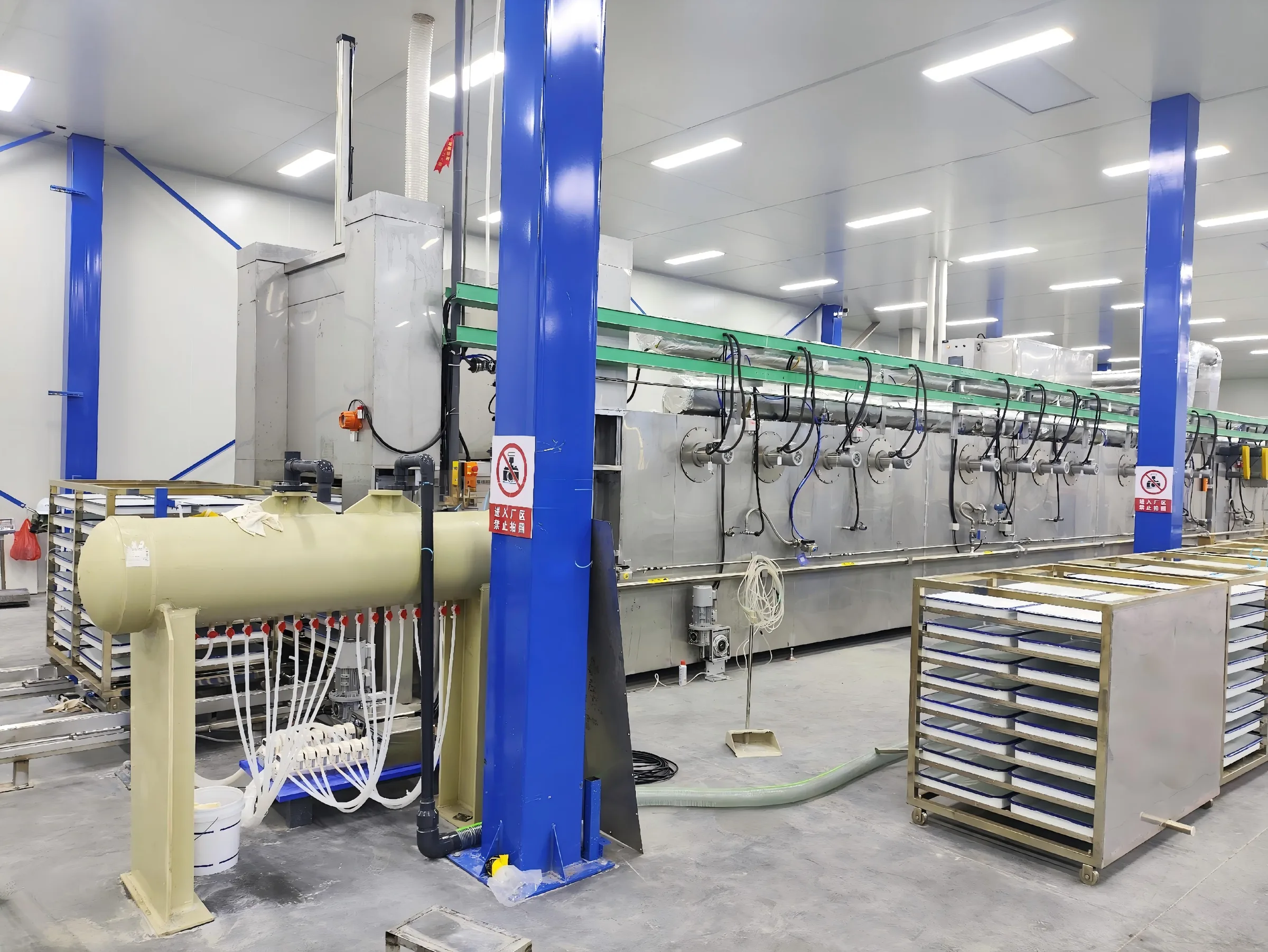
Why Nitrogen Protection Matters in Silicon-Carbon Anode Slurry Drying
For the silicon-carbon anode slurry line covered by this project, nitrogen protection is not optional. It is a required process condition during the drying of high-moisture lithium-ion battery material slurry. That means the gas system must be designed with the drying system from the beginning.
The correct question is not "Can nitrogen be added to an oven?" It is "How should the nitrogen-protected drying process be configured for this slurry, target moisture and production line?"
Nitrogen protection is a system requirement
A nitrogen-protected drying line has to bring together several elements:
| System element | Engineering purpose |
|---|---|
| Nitrogen supply and distribution | Delivers the specified process gas to the drying system |
| Continuous tray oven | Provides the controlled multi-zone thermal path |
| Circulation and exhaust fans | Manage gas movement and moisture removal |
| Temperature and humidity instruments | Provide the operating information used by the control system |
| Interlocks and alarms | Support the agreed process and equipment-safety logic |
| Exhaust and dehumidification arrangement | Manage moisture and process gas according to the site design |
In the nitrogen-protected continuous tray oven, these elements are considered together with trolley movement, automatic doors and the heating profile.
What must be confirmed before design
The project agreement identifies nitrogen as a required utility, but it does not turn one project value into a universal specification. Before final design, confirm:
- required nitrogen purity;
- oxygen limit and the method used to verify it;
- gas flow requirement by operating condition;
- start-up, shutdown and abnormal-condition logic;
- exhaust destination and any gas-treatment requirement; and
- the interaction between nitrogen, moisture removal and the temperature profile.
These values come from the battery-material process owner. They should not be invented for a product page or copied from an unrelated battery application.
Why it affects equipment selection
When drying a liquid slurry with more than 90% water, the line has to manage a substantial moisture load while maintaining the specified process atmosphere. That affects more than the chamber material. It affects fan selection, ducting, instrumentation, door and transfer details, exhaust design and the PLC sequence.
For this reason, Zhengyuan positions the system as a silicon-carbon anode slurry drying solution, not as a standard batch oven. The line uses a controlled multi-zone tray path so the gas and heating conditions can follow the drying process.
Nitrogen protection does not mean unsupported claims
It is important to describe the system accurately. Nitrogen protection may be required by the process, but that alone does not justify claims about:
- a fixed oxygen ppm;
- explosion-proof certification;
- a specific electrochemical-performance improvement; or
- universal suitability for every silicon-carbon formulation.
Those claims require documented process criteria, equipment specification and validation. The reliable message is that Zhengyuan engineers a nitrogen-protected continuous tray drying line around the confirmed battery-material requirement.
Related battery-material processes
Battery materials do not all use the same drying method. Silicon-carbon anode slurry in this project uses a tray-based, nitrogen-protected route. NMC precursor, by comparison, is covered on this site as a conductive disc-drying process. The right choice follows the material form and process requirement.
---
Nitrogen purity, oxygen limit, gas flow and exhaust requirements must be defined by the material owner and validated in the final process design.