
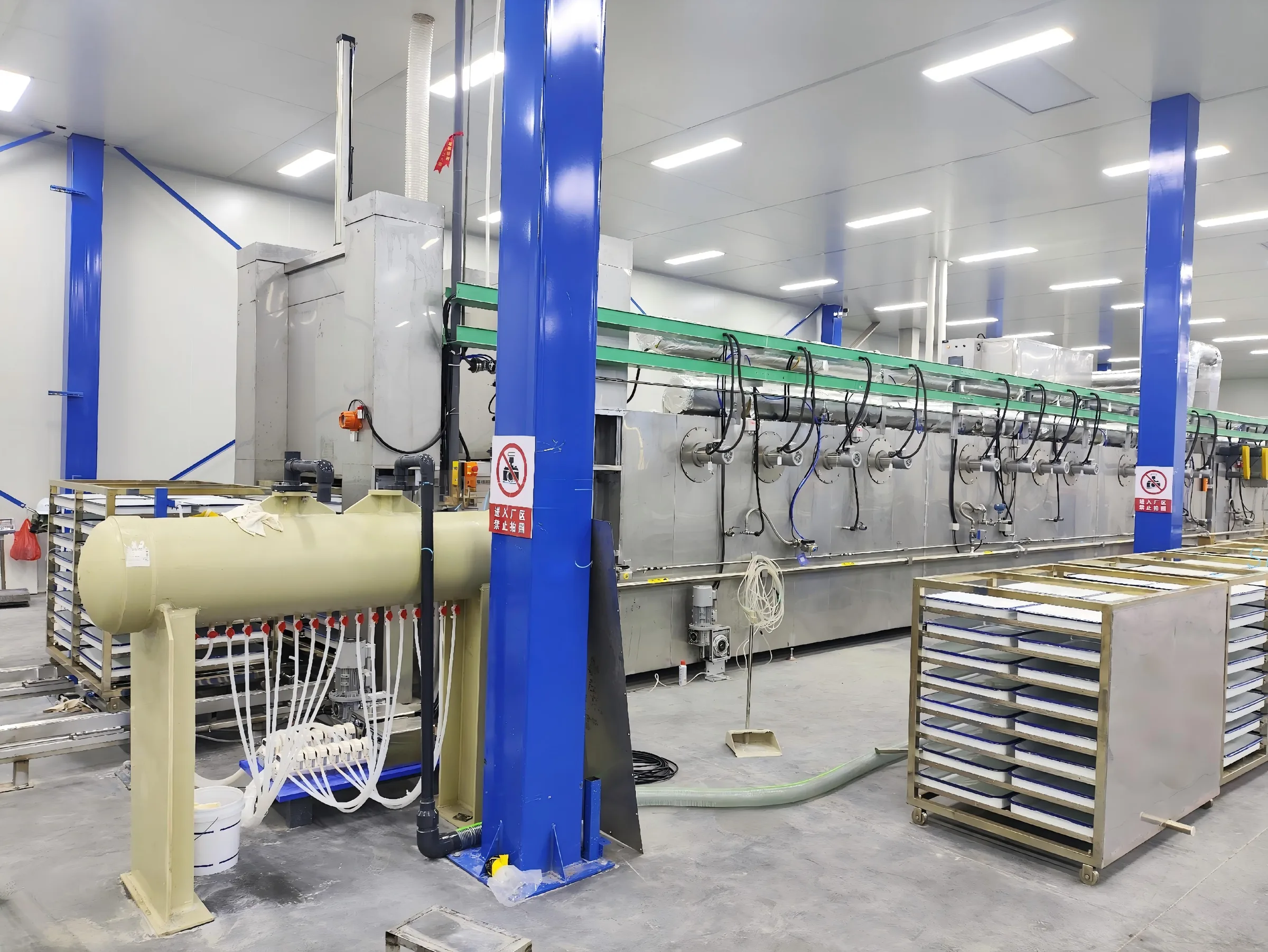
Nitrogen-Protected Continuous Tray Oven for Lithium-Ion Battery Materials
Nitrogen-protected continuous tray oven for drying high-moisture silicon-carbon anode slurry. Multi-zone steam and electric heating, automated trolley transfer and PLC process records.
The Zhengyuan nitrogen-protected continuous tray oven is a multi-zone drying system for lithium-ion battery materials that need controlled tray residence rather than simple batch oven drying. It is configured for high-moisture liquid slurry, including silicon-carbon anode slurry, with automated trolley transfer, staged heating, humidity management and PLC process records.
For the silicon-carbon anode application, nitrogen protection is a required process condition. The line is therefore engineered around the required atmosphere and drying profile, not treated as a standard hot-air circulation oven with nitrogen added later.
Built for continuous battery-material drying
- Continuous tray path. Trolley-mounted trays move through the oven in a controlled sequence, supporting a repeatable residence time and steady production rhythm.
- Two-stage drying profile. Early zones remove free water at a controlled temperature; later zones complete final drying under the validated process profile.
- Nitrogen-protected process. Nitrogen supply, circulation, exhaust and interlocks are designed around the customer's atmosphere requirement.
- Multi-zone heating. Steam and electric heating can be arranged by zone so the temperature profile follows the material's drying behavior.
- Corrosion-aware construction. 316L and duplex 2205 stainless steel are available for specified process-contact and hot-gas areas.
- Automated handling and safety. Mechanical trolley transfer, automatic lifting doors, emergency stop, safety light curtains and labelled electrical controls support line operation.
- Traceable operation. Temperature and humidity values can be displayed, trended, stored and exported through the control system.
Why tray drying for silicon-carbon anode slurry?
Silicon-carbon anode slurry entering the line with more than 90% water has a large evaporation duty. The process must remove that water without applying one uncontrolled temperature to the entire moisture range. A continuous tray oven creates a defined thermal path: the slurry is loaded to trays by the upstream process, carried through controlled zones, and discharged after the specified drying cycle.
This is different from a standard hot air circulation oven, which is generally a batch unit. It is also different from a disc continuous dryer, which uses conductive drying and is selected for different material forms and process requirements. The right technology depends on slurry behavior, target product form, atmosphere requirement and validated quality criteria.
Reference configuration: LXHX-22
The following values describe a project reference configuration, not a universal product guarantee.
| Item | Reference configuration |
|---|---|
| Equipment type | LXHX-22 nitrogen-protected continuous tray oven |
| Intended material form | High-moisture liquid silicon-carbon anode slurry |
| Initial moisture | More than 90% water, wet basis |
| Final moisture | Below 10%, subject to confirmed process conditions |
| Drying temperature | Configured within a 60-220 C operating range |
| Heating | Steam in early zones and electric heating in later zones |
| Atmosphere | Nitrogen is a required process utility |
| Process-contact construction | Specified 316L and duplex 2205 stainless steel |
| Trolley system | 28 trolley positions and 896 tray positions in the reference line |
| Reference capacity | Up to 8 t/day, depending on slurry and process settings |
| Data and protection | Temperature/humidity records, over-temperature alarm, heat-source cut-off and safety interlocks |
How the staged process works
1. Controlled free-water removal
The first section is set for controlled removal of free water. In the reference design, steam heating is used in the early units so the process can establish an appropriate low-temperature evaporation stage before the slurry reaches the higher-temperature section.
2. Final drying by independently controlled zones
Later units use electric heating in the reference configuration. Each unit has independent temperature control so the profile can be adjusted during commissioning and according to the material's validated drying window. The purpose is not simply to raise temperature; it is to complete moisture removal in a repeatable manner.
3. Nitrogen, humidity and exhaust management
The line must be designed as a system: nitrogen supply, circulation fans, exhaust fans, humidity measurement and any upstream dehumidification equipment have to work together. The required gas conditions are defined by the lithium-ion battery material process, not by a generic oven setting.
4. Automated transfer and recorded operation
Mechanical entry and discharge transfer, automatic doors and programmed operation reduce manual handling around a long high-temperature line. The PLC system records key operating values so production and maintenance teams can review the drying history.
Configuration inputs we need
To size a continuous tray dryer for lithium-ion battery material, please provide:
| Process input | Why it matters |
|---|---|
| Wet-basis feed rate and water content | Defines water evaporation duty and line capacity |
| Tray loading depth and slurry rheology | Determines tray area, loading method and drying behavior |
| Target moisture and test method | Sets the final drying requirement |
| Nitrogen purity, oxygen limit and exhaust requirement | Defines the atmosphere design and interlocks |
| Binder, solvent and impurity restrictions | Confirms material compatibility and safe process design |
| Available steam, electrical power and cooling water | Determines the heating and utility configuration |
For an application-specific design, see the silicon-carbon anode slurry drying solution. Zhengyuan also supplies battery-material equipment for other process routes, including the NMC precursor drying solution.
---
Reference values describe a specific project configuration. Verify all temperatures, utilities, atmosphere requirements and performance values against your own material and process specification before relying on them as guarantees.
Frequently Asked Questions
Product Categories
Start Optimizing Your Drying Process Today
Contact our experts for pricing, customization options, and technical support for Nitrogen-Protected Continuous Tray Oven for Lithium-Ion Battery Materials.