
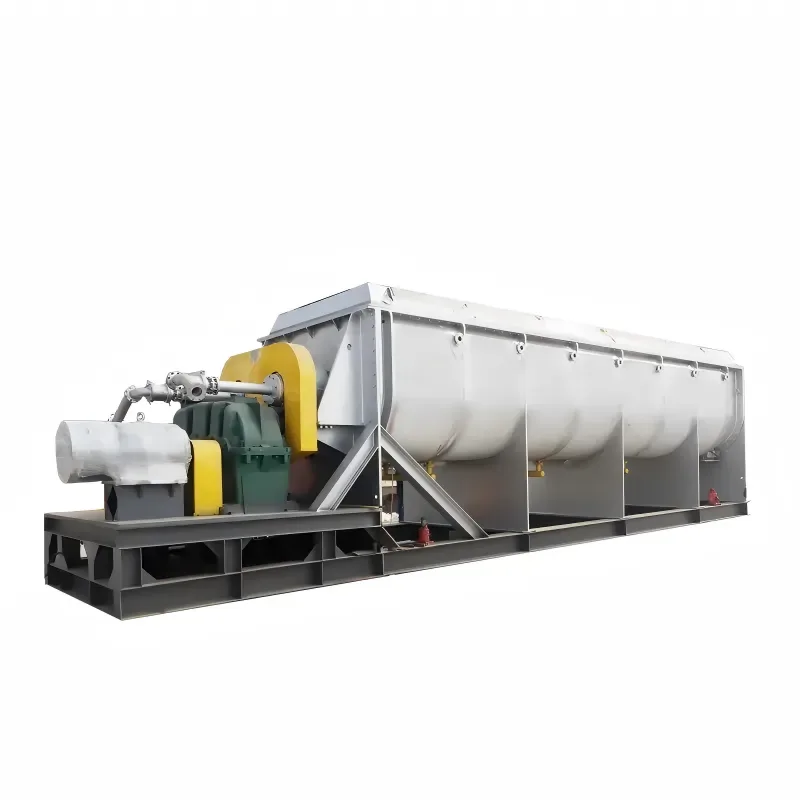
Sludge Dryer
Hollow paddle sludge dryer heated indirectly by steam or thermal oil. A small exhaust volume keeps odour treatment down. Eleven sizes, 3–110 m² of heat-transfer area.
Overview
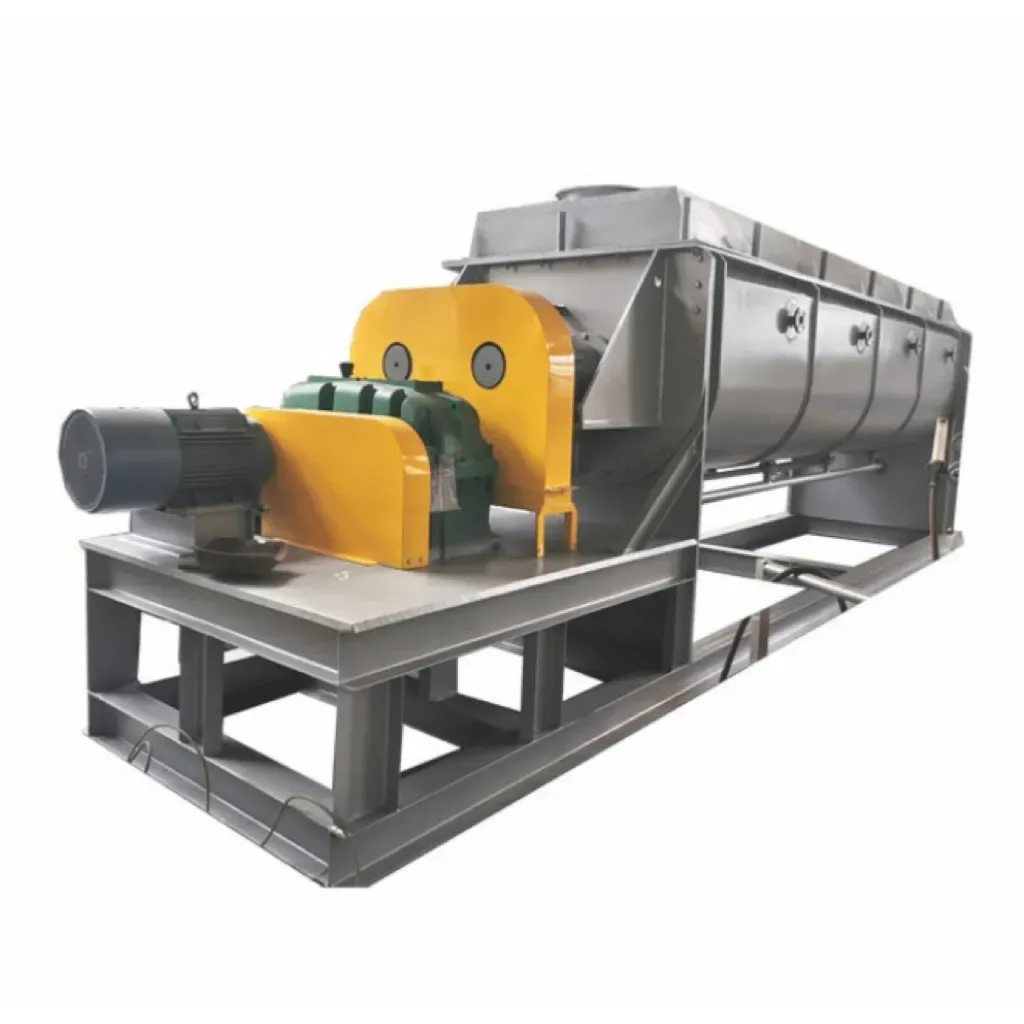
The sludge dryer is a hollow paddle dryer configured for municipal and industrial sludge. Dewatered cake is fed into an Ω-shaped trough where two to four hollow shafts, fitted with wedge-shaped hollow paddles, carry steam or thermal oil and dry the sludge by direct contact with the heated surfaces. No hot air passes through the material.
Eleven sizes are built, from 3 to 110 m² of heat-transfer area.
Why indirect heating suits sludge
Sludge is the case where the heating method decides the cost of the whole installation, not just the dryer.
- The exhaust is small. Heat reaches the sludge through metal, not through an air stream, so the only vapour leaving is the water driven off. A convective dryer must push a large volume of hot air through the material and then treat all of it. On an odorous feed, the deodorising plant is sized on that gas volume — and it is often the larger capital item.
- The trough is closed. The Ω shell is sealed by end and top covers, which keeps odour and dust inside the machine rather than in the building.
- The heat-transfer surface cleans itself. Sludge sticks. The relative motion of the material against the wedge faces scrubs them as the shafts turn, so the surface stays effective instead of insulating itself with a baked-on layer.
- The temperature can stay low. The heat medium runs anywhere from -40 to 320°C — steam, thermal oil or hot water — so the duty can be set to the sludge rather than to what the burner happens to deliver.
Steam consumption
Roughly 1.2 kg of steam per kg of water evaporated on slurry feeds. It is the number to start a utility estimate from, and it is worth confirming against your own sludge: consumption moves with feed solids, the steam pressure available and the outlet moisture you need.
Sizing
Paddle dryers are sized by heat-transfer area, not by volume or by throughput.
Work out the water you need to evaporate per hour, then read the heat-transfer area row of the specification table below. The eleven sizes span 3 to 110 m², with installed power from 2.2 to 95 kW and shaft speeds between 5 and 30 rpm.
Effective volume is given as well, and matters for residence time — a sludge that needs longer at temperature needs volume as much as it needs area.
What to tell us when enquiring
Sludge varies more than almost any other feed, so a model cannot be picked from a tonnage alone:
- Where the sludge comes from — municipal, dyeing, electroplating, papermaking, food
- Inlet moisture after dewatering, and the outlet moisture you need
- Throughput, as wet cake per hour
- Whether the dried product is going to landfill, incineration, co-firing or reuse
- The heat medium available on site — steam pressure, thermal oil, hot water
- Any odour or emission limit you have to meet
Features
- Indirect conduction heating — no air blown through the sludge, so little to deodorise
- Sealed Ω-shaped trough with end and top covers keeps odour and dust contained
- Wedge-shaped hollow paddles present a large heated area in a small footprint
- Self-scrubbing paddle faces hold their heat-transfer rate on sticky material
- Two to four shafts by size, 5–30 rpm
- Heat medium from -40 to 320°C: steam, thermal oil or hot water
- Also runs as a cooler, and for heating, reaction and sterilisation duties
Applications
Municipal sewage sludge; dyeing, electroplating, papermaking and petrochemical sludge; and other high-viscosity, high-moisture residues where exhaust volume and odour have to be kept under control.
Technical Specifications
| Model | JYG3 | JYG9 | JYG13 | JYG18 | JYG29 | JYG41 | JYG52 | JYG68 | JYG81 | JYG95 | JYG110 |
|---|---|---|---|---|---|---|---|---|---|---|---|
| Heat Transfer Area (m²) | 3 | 9 | 13 | 18 | 29 | 41 | 52 | 68 | 81 | 95 | 110 |
| Effective Volume (m³) | 0.06 | 0.32 | 0.59 | 1.09 | 1.85 | 2.8 | 3.96 | 5.21 | 6.43 | 8.07 | 9.46 |
| Speed Range (r.p.m) | 15-30 | 10-25 | 10-25 | 10-20 | 10-20 | 10-20 | 10-20 | 10-20 | 5-15 | 5-15 | 5-10 |
| Power (kW) | 2.2 | 4 | 5.5 | 7.5 | 11 | 15 | 30 | 45 | 55 | 75 | 95 |
| Body Width A (mm) | 306 | 584 | 762 | 940 | 1118 | 1296 | 1476 | 1652 | 1828 | 2032 | 2210 |
| Overall Width B (mm) | 736 | 841 | 1066 | 1320 | 1474 | 1676 | 1854 | 2134 | 1186 | 2438 | 2668 |
| Body Length C (mm) | 1956 | 2820 | 3048 | 3328 | 4114 | 4724 | 5258 | 5842 | 6020 | 6124 | 6122 |
| Overall Length D (mm) | 2972 | 4876 | 5486 | 5918 | 6808 | 7570 | 8306 | 9296 | 9678 | 9704 | 9880 |
| Feed-Discharge Distance E (mm) | 1752 | 2540 | 2768 | 3048 | 3810 | 4420 | 4954 | 5384 | 5562 | 5664 | 5664 |
| Center Height F (mm) | 380 | 380 | 534 | 610 | 762 | 915 | 1066 | 1220 | 1220 | 1220 | 1220 |
| Overall Height H (mm) | 762 | 838 | 1092 | 1270 | 1524 | 1778 | 2032 | 2362 | 2464 | 2566 | 2668 |
| Steam Inlet N (inch) | 3/4 | 3/4 | 1 | 1 | 1 | 1 | 1 1/2 | 1 1/2 | 1 1/2 | 1 1/2 | 2 |
| Water Outlet O (inch) | 3/4 | 3/4 | 1 | 1 | 1 | 1 | 1 1/2 | 1 1/2 | 1 1/2 | 1 1/2 | 2 |
Frequently Asked Questions
Product Categories
Start Optimizing Your Drying Process Today
Contact our experts for pricing, customization options, and technical support for Sludge Dryer.