
Spray Dryer Types: Atomizers & Machine Configurations
"Spray dryer" covers a family of machines that differ in two ways: how they atomize the liquid, and how the overall system is configured. Choosing the right combination is what matches the dryer to your material.
By atomizer
The atomizer sets the particle size and decides which feeds the dryer can handle.
- Centrifugal (rotary) atomizer — a disc spinning at up to about 25,000–30,000 rpm flings the liquid into droplets. It gives a large throughput and an even particle size and suits low-viscosity feeds, so it is the workhorse for milk powder, coffee and dyes. Particle distribution is somewhat wider (about 10–300μm).
- Pressure (nozzle) atomizer — a high-pressure pump (2–20 MPa) forces liquid through a fine nozzle (orifice 0.1–2 mm), giving a uniform particle size (10–100μm) and suiting higher-viscosity slurries such as ceramic glaze, catalysts and nano materials; the nozzle wears.
- Two-fluid (airflow) atomizer — compressed air (≥300 m/s) shears the liquid apart. The nozzle is inexpensive and resists clogging, which suits viscous pastes and heat-sensitive or small-batch feeds such as enzymes and vitamins, at higher energy cost.
By system configuration
- Laboratory spray dryer — compact, often with a glass observation chamber, throughput just 0.1–5 L/h and sample recovery ≥95%, for R&D and small-batch trials including viscous samples.
- Industrial (open-cycle) spray dryer — built around a centrifugal atomizer for continuous production at tens to hundreds of litres per hour, with adjustable particle size, for milk powder, ceramic powders and other large-scale powders.
- Closed-cycle spray dryer — fully sealed with nitrogen protection and a solvent-recovery system, for feeds containing ethanol or other organic solvents and for flammable or oxidation-sensitive materials, giving safe, near-zero-emission operation.
- Low-temperature / vacuum spray dryer — drying temperatures as low as 35°C, often combined with vacuum, to preserve the activity of highly heat-sensitive materials such as probiotics and enzymes.
Choosing a type
A practical starting point:
- Heat-sensitive feeds (pharmaceuticals, probiotics) → centrifugal or two-fluid atomizer with a low inlet temperature (<150°C), or a low-temperature/closed configuration.
- High-viscosity feeds (polymer solutions) → centrifugal or pressure atomizer, with anti-wall-sticking features such as a vibrated chamber wall.
- Feeds with solid particles (slurries, ceramic suspensions) → two-fluid or pressure atomizer with a wear-resistant nozzle.
- Sterile feeds (injectables) → a closed configuration with a CIP cleaning system.
Figures are industry-typical; verify against your material before relying on them.
See how the parts fit together in spray dryer components, or how each type is used in spray dryer applications.
Frequently Asked Questions
Related Products
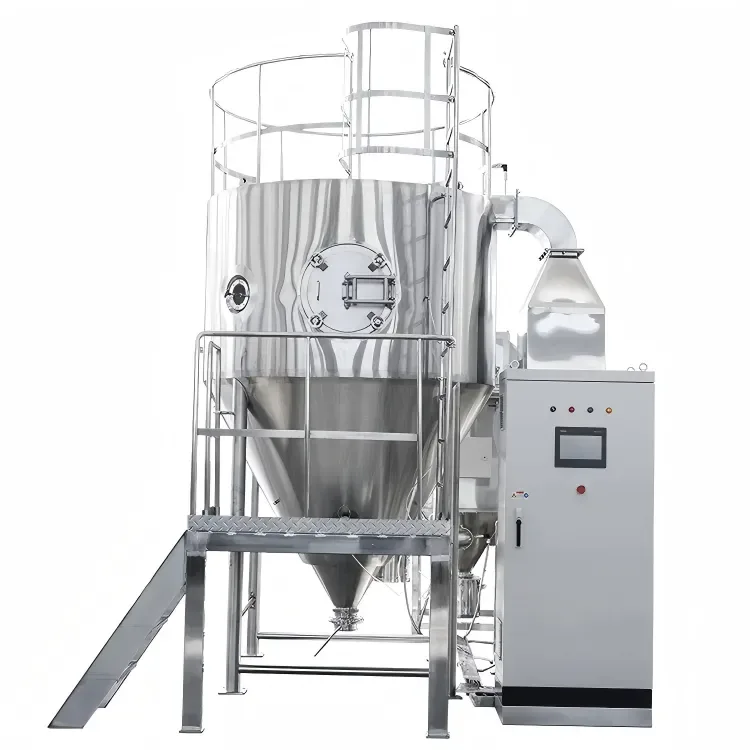
High-Speed Centrifugal Spray Dryer
Centrifugal spray dryer turning solutions, suspensions, emulsions and pastes into powder in one pass. Models from 5 to 2,000 kg/h water evaporation.
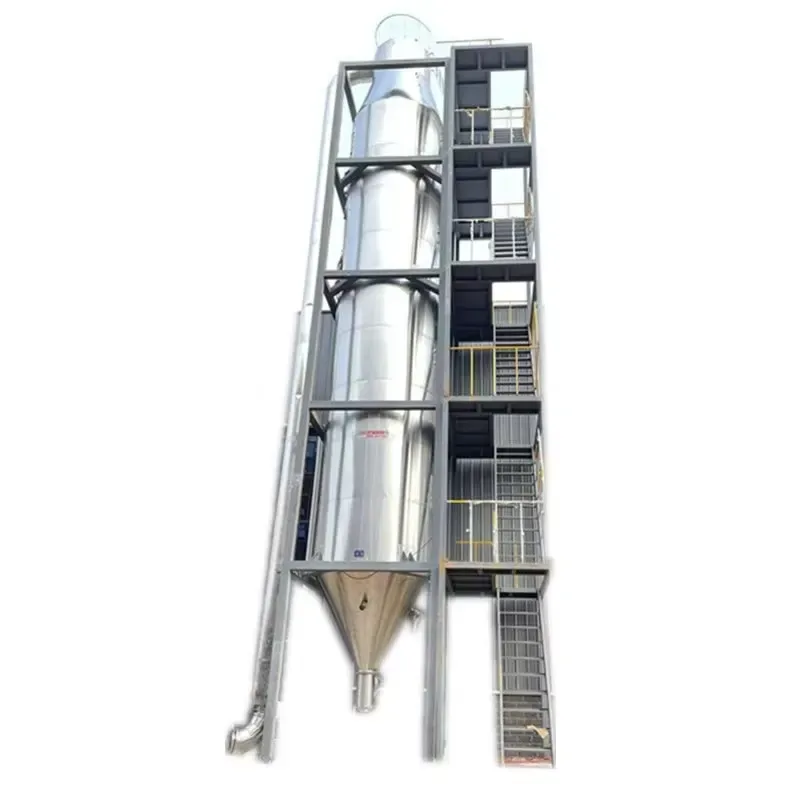
Pressure Spray Dryer
Pressure-nozzle spray dryer that dries and granulates in one step, producing uniform spherical granules with good flow and solubility.
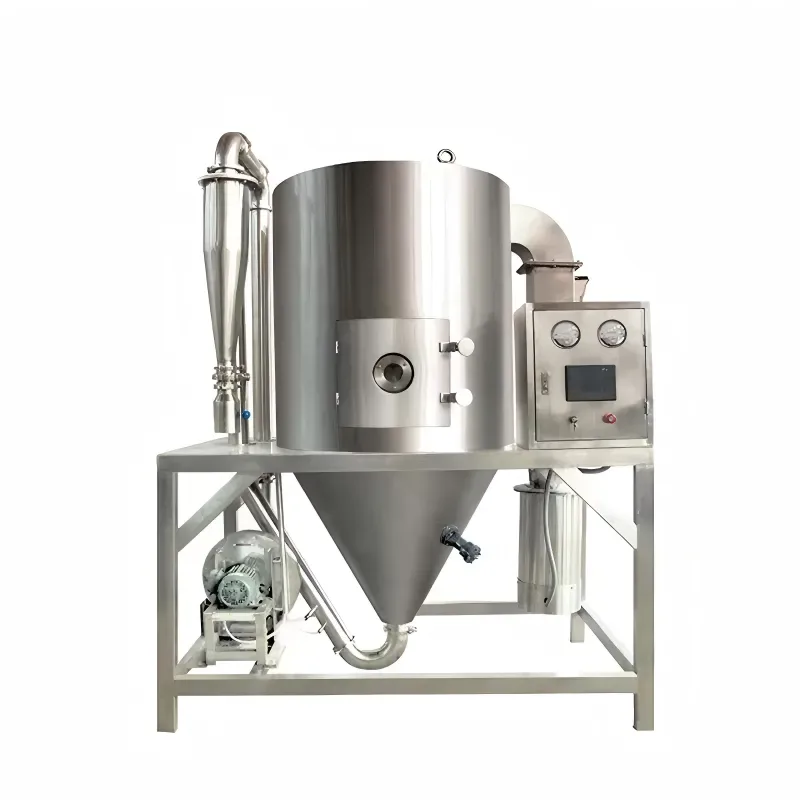
Herbal Extract Spray Dryer
Spray dryer purpose-built for low-melting, high-sugar herbal extracts, preventing wall-sticking, charring and moisture absorption.