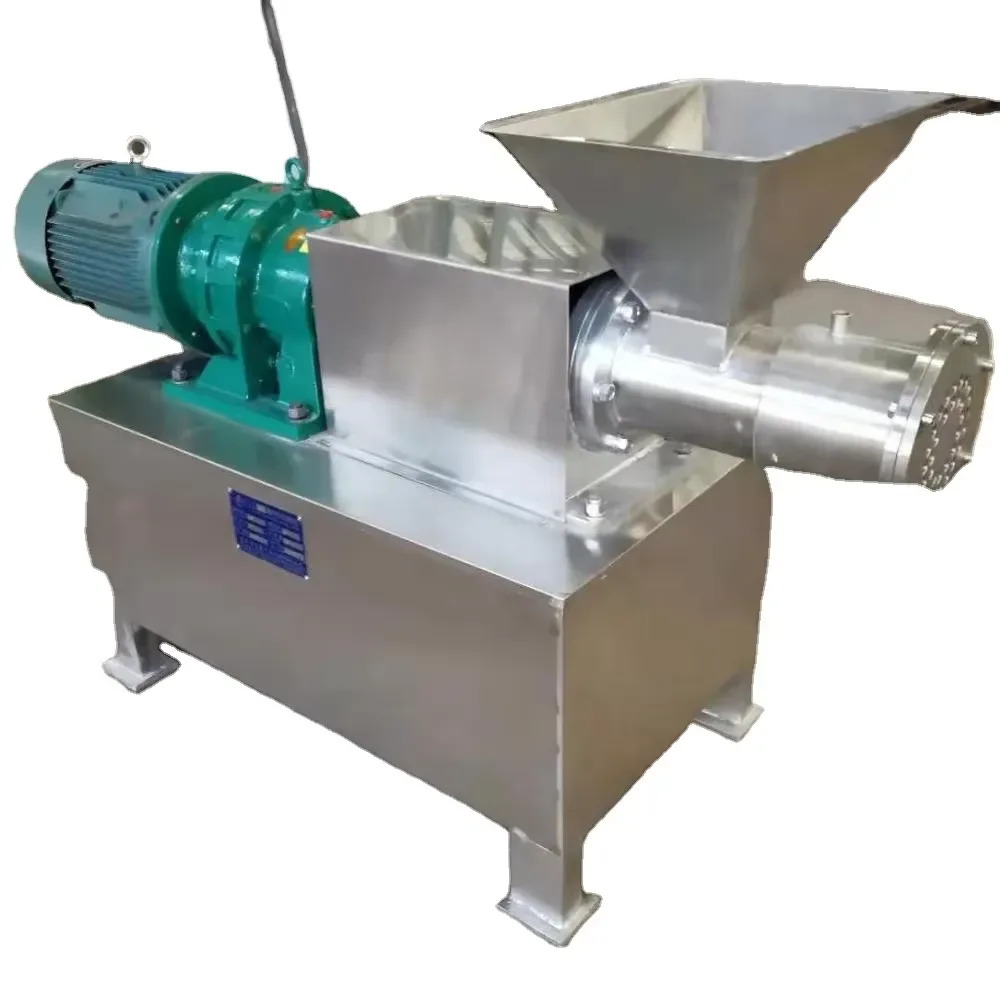
Roller Compaction for Moisture- and Heat-Sensitive Powders
Wet granulation is the default in pharmaceutical production, and for good reason — it produces granules that flow and compress well. But it does two things some formulations cannot survive: it adds water, and it applies heat to remove that water again.
Roller compaction does neither.
When stability decides for you
Three failure modes push a formulation toward dry granulation, and none of them is negotiable:
Hydrolysis. An active that reacts with water begins degrading the moment the binder solution touches it. Drying afterwards does not undo the reaction. Even a short exposure at the wetting stage can put an assay outside specification by the end of shelf life.
Thermal degradation. Drying a wet granulate means holding it at elevated temperature until the moisture is gone. For a thermolabile active, that residence time at temperature is exactly what the stability data says to avoid.
Polymorphic change. Some crystalline actives convert to a different form when wetted and dried — a hydrate forming, or one anhydrous form converting to another. Different forms can dissolve at different rates, which puts bioavailability at risk. Dry processing avoids the transition entirely.
When any of these apply, the choice is made. The comparative merits of high-shear and fluid bed granulation become irrelevant, because both begin by wetting the material.
How the process works
A roller compactor turns powder into granules in four stages, all continuous:
- Feeding. A screw conveys powder into the gap between two rollers, de-aerating it on the way.
- Compaction. The counter-rotating rollers compress the powder into a hard ribbon — the pressure alone creates particle-to-particle bonds, with no binder liquid involved.
- Milling and sizing. The ribbon is broken and milled, then screened to the target size.
- Recycling. Undersize fines return to the feed rather than being discarded.
Note that granulation happens by pressure only. There is no binder solution, so the bonds holding a dry granule together come from the material's own plastic deformation under load. That is both how the process works and where its main limitation comes from.
Ribbon density is the whole game
Roller compaction has one intermediate that determines the outcome, and it is not the granule — it is the ribbon.
Ribbon density governs:
- Granule size distribution — a denser ribbon breaks into coarser granules
- Fines generation — an under-compacted ribbon crumbles instead of breaking cleanly
- Compression behaviour — how the granules perform at the tablet press
Three settings set it, and they interact:
| Setting | Direct effect | Interaction to watch |
|---|---|---|
| Roller pressure | Higher gives denser, harder ribbon | Raising it too far causes the compressibility loss below |
| Roller speed | Faster reduces dwell time under load | Must be balanced against feed rate or the gap changes |
| Feed screw speed | Sets how much material enters the nip | Changes the gap, and therefore density, at constant pressure |
That last interaction catches people out. Raising the feed rate without touching the pressure setting still changes ribbon density, because more material in the nip opens the gap. The pressure dial has not moved, but the product has changed.
Establish the combination that gives the ribbon you need, and hold all three.
The compressibility cost
This is the part worth understanding before committing to the route.
Powder compacted into a ribbon has already undergone plastic deformation. Particles have flowed, bonded and work-hardened. When those granules later reach the tablet press, part of the bonding capacity has already been spent.
The result: tablets from roller-compacted granules can be softer at the same compression force than tablets from wet-granulated material. The effect is well documented in the literature and is not a defect in any particular machine.
What matters is that it is manageable:
- Do not over-compact. The instinct to run maximum pressure for a clean ribbon is exactly wrong — it spends more of the bonding capacity than necessary.
- Target the lowest ribbon density that mills cleanly. That leaves the most capacity for the tablet press.
- Assess it during formulation development, not during validation. Compression behaviour should be characterised on roller-compacted granules early enough that excipient choices can still change.
Reduced compactibility is a real cost. It is usually a much smaller cost than a stability failure — but it should be a decision, not a surprise.
Fines, and what they tell you
Every roller compactor generates fines, and every roller compactor recycles them. A high recycle rate is not a catastrophe, but it is a signal.
Excessive fines usually mean the ribbon is too weak — compacted at insufficient pressure, so it crumbles rather than breaking into granules. Inconsistent feed is the other common cause: a ribbon of varying density mills unevenly, and the thin sections shatter.
Watch the recycle rate as a process indicator. Rising fines with settings unchanged usually points to a feed problem — a change in incoming powder density, a partially blocked screw, or segregation in the hopper — before it points to the rollers.
De-aeration
Low-density powders carry a lot of air. That air has to escape somewhere, and if it escapes backwards through the feed screw it disrupts the flow into the nip — giving exactly the inconsistent ribbon that causes fines.
Feed screw design handles this in most cases. Where the powder is very light or throughput is high, vacuum de-aeration is used to remove air before the material reaches the rollers. Whether it is needed is a material question, settled during trials rather than assumed.
What to establish during development
| Parameter | Why |
|---|---|
| Target ribbon density | The controlling intermediate; everything else follows |
| Roller pressure, speed and feed rate | The combination that produces it |
| Granule size distribution | Confirms the sizing screen and mill settings |
| Fines recycle rate | Baseline for detecting drift in production |
| Compression profile of the granules | Quantifies the compressibility cost for this formulation |
| Content uniformity after recycling | Recycled fines pass through compaction twice |
That last row is worth attention where the drug load is low. Material that has been recycled has been compacted more than once, and if the active and excipients segregate during recycling, uniformity can drift.
When not to use it
Roller compaction is not the answer simply because it is dry:
- If the formulation tolerates wetting and tablet hardness at low compression force is a priority, a wet route usually gives better tablets.
- If the powder does not deform plastically, it will not form a coherent ribbon at any pressure. Brittle materials that fracture rather than flow are poor candidates.
- If the target is spherical pellets rather than granules, neither route applies — that is extrusion and spheronization.
Talk to Zhengyuan
Send us the formulation, its stability constraints, the compaction behaviour if you have characterised it, and the required output. We will size a GFZL roller compactor against it — and where the formulation would tolerate a wet route and compress better for it, we will tell you that instead.