
High-Shear vs Fluid Bed Granulation: Which Route Fits
Both routes wet powder with a binder and turn it into granules. They do it by opposite means, and the granules that come out are not interchangeable.
The short version: high shear packs particles together by force; a fluid bed lets them come together in suspension. Density, compressibility, cycle time and how much attention the process needs all follow from that.
How each builds a granule
High shear. Powder sits in a closed bowl. A bottom impeller drives the mass around while binder is sprayed in. As wetting proceeds the impeller shears and compresses the wet mass, packing particles into dense agglomerates. A high-speed side chopper cuts through lumps to stop them growing beyond target. Granule growth comes from mechanical work.
Fluid bed. Powder is suspended in an upward air stream. A nozzle above the bed sprays binder down onto the fluidised particles. Droplets bridge particles together where they touch, and continued fluidisation dries those bridges in place. Granule growth comes from droplets landing and solidifying, with no mechanical compaction at all.
That is the whole difference. Everything below is a consequence of it.
The comparison
| High shear | Fluid bed | |
|---|---|---|
| Growth mechanism | Mechanical shear and densification | Droplet bridging in suspension |
| Granule structure | Dense, strong | Porous, friable |
| Bulk density | Higher | Lower |
| Compressibility | Lower | Higher |
| Granulation time | Minutes | Tens of minutes |
| Drying | Separate machine | Same chamber |
| Machines needed | Granulator plus dryer | One |
| Process window | Narrow — end point critical | Wide — gradual growth |
| Shear on the product | High | Minimal |
| Binder quantity | Less | More |
Density against compressibility
This is the trade-off that decides most selections.
Fluid bed granules are porous. Under compression, pores collapse and the material deforms and interlocks, so tablets form at lower compression force. Where an active compresses poorly, that headroom is valuable — you can reach target hardness without pressing so hard that the tablet caps or laminates.
High-shear granules are dense. They resist deformation, so more force is needed for the same hardness. What they give in return is mass in a fixed volume: a die of set dimensions holds more material, which matters for high drug loading, and denser granules segregate less in the hopper, which helps content uniformity.
Neither is better. A poorly compressible active argues for fluid bed. A high drug load in a small tablet argues for high shear.
Cycle time, measured honestly
High-shear granulation is often described as the fast route, and the granulation step is: minutes against tens of minutes.
But high-shear granules leave the bowl wet. They must be transferred to a dryer, dried, and often milled afterwards. A fluid bed granulator dries in the same chamber, with no transfer at all.
Compare end to end, from powder charged to granules ready for compression, and the gap narrows to a matter of what dryer sits next to the granulator. Compare the step only, and the answer is misleading.
Process control
Fluid bed granulation is forgiving. Granules grow gradually over the spray phase. The process can be sampled, and spray rate or air temperature adjusted, while it runs. The main thing to hold is the balance between spray rate and drying rate — spray too fast and the bed over-wets and collapses; dry too aggressively and the granules never grow.
High-shear granulation is not forgiving. The end point — where granules reach target size and density — can pass in under a minute. Beyond it the mass keeps densifying into a paste that no longer breaks into usable granules. Production therefore tracks impeller power draw or motor torque, which rise measurably as the wet mass builds, and stops on that signal rather than on a clock.
Neither is difficult. But high shear demands a monitored end point, and that requirement should be in the specification from the start rather than added after the first over-granulated batch.
Shear sensitivity
Some materials do not tolerate mechanical work. Friable crystals fracture under an impeller. Some actives change polymorphic form under combined shear and moisture. Coated particles that must survive into the tablet will not survive a high-shear bowl.
Fluid bed granulation applies almost no mechanical stress — particles are carried in air and touch each other gently. Where shear is a known risk, that alone can decide the route.
Scale-up
Both scale, differently.
High shear scales on impeller tip speed, not shaft rpm. A larger impeller reaches the same tip speed at lower rotation, which is why a 10 L bowl runs at 600 rpm and a 600 L bowl at 120. Holding rpm constant across sizes is a common and expensive scale-up error.
Fluid bed scales on air volume per unit of bed cross-section, together with spray rate per unit of drying capacity. Nozzle count usually changes with size, so spray pattern is not simply multiplied.
Neither transfers by proportional arithmetic. Plan trials at each scale.
Choosing
Choose high shear when
- drug loading is high and there is little room for excipients
- bulk density matters — for die fill, content uniformity or segregation
- granulation cycle time drives throughput and a dryer is already available
- the formulation tolerates mechanical work
Choose fluid bed when
- the active compresses poorly and compressibility headroom is needed
- the material is shear-sensitive
- combining granulation and drying in one machine simplifies the line or the cleanroom
- dust containment matters and fewer transfers are an advantage
Choose neither when
- the active hydrolyses, degrades on drying or changes form on wetting. Then the route is dry granulation by roller compaction, which uses no liquid and no heat. Stability overrides every advantage the wet routes offer.
What decides it in practice
In our experience the selection usually comes down to three questions, in this order:
- Can the formulation be wetted and dried at all? If not, the wet routes are out regardless of their merits.
- Does the active compress well? Poor compressibility pushes toward fluid bed.
- How much active is in the tablet? High loading pushes toward high shear.
Everything else — cycle time, footprint, number of machines — matters, but rarely overrides those three.
Talk to Zhengyuan
Send us the formulation, drug loading, compression behaviour, stability constraints and batch size range. We will recommend the route that fits the product, including telling you when the answer is the machine we did not quote.
Frequently Asked Questions
Related Products
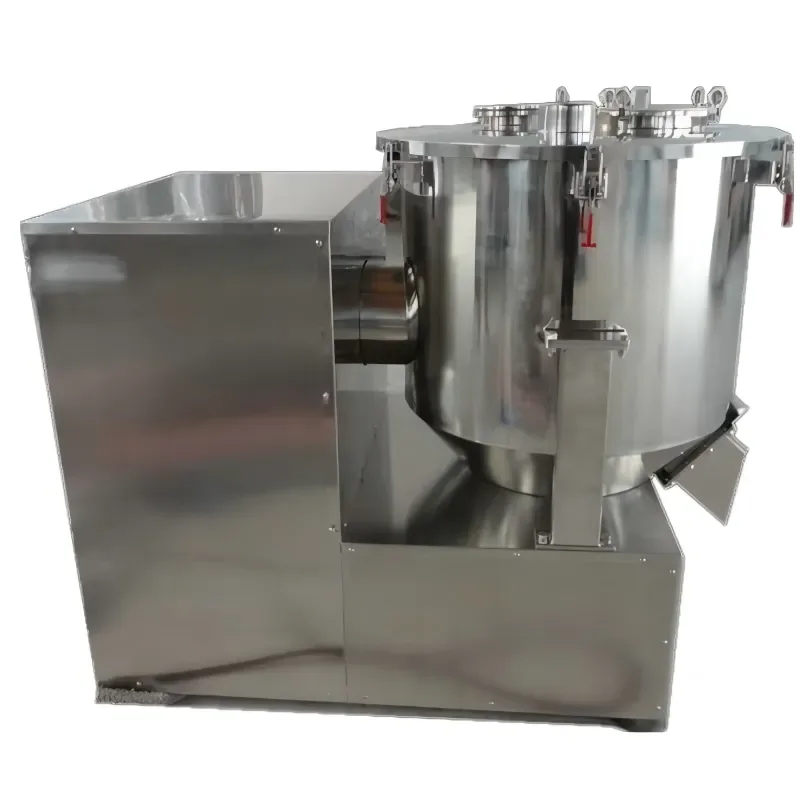
High-Shear Wet Granulator (RMG) for Pharma Granulation
GHL high-shear wet granulator — rapid mixer granulator with impeller and chopper producing dense, uniform granules in one closed vessel. Eight models, 10–600 L.
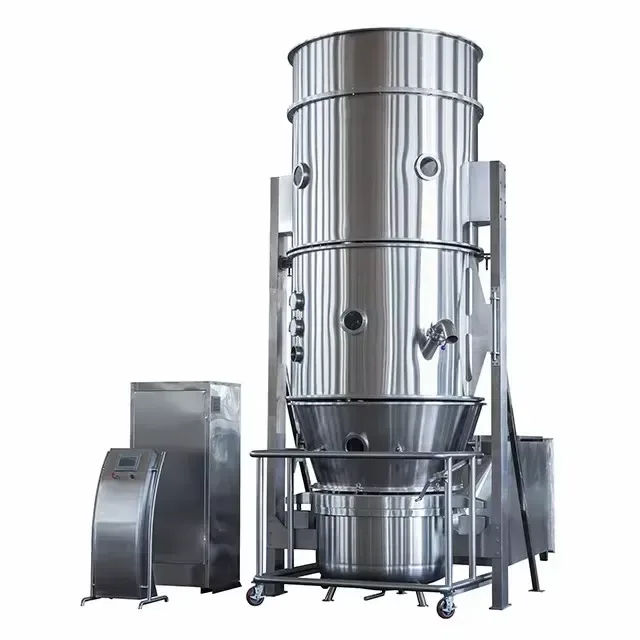
Fluid Bed Granulator — One-Step Granulation and Drying
FL fluid bed granulator mixes, granulates and dries in one closed chamber, giving porous, free-flowing granules. Nine models, 12–1500 L.
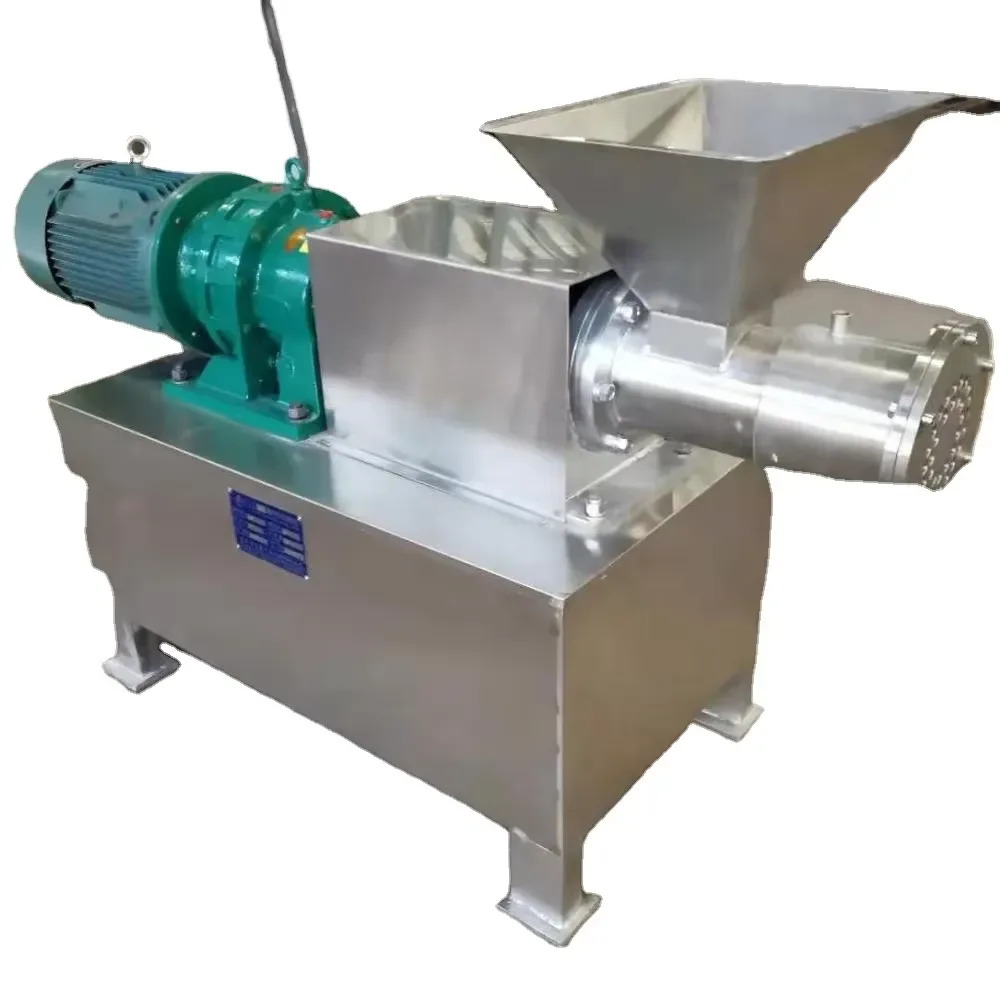
Roller Compactor — Dry Granulation Without Liquid or Heat
GFZL roller compactor for dry granulation of moisture- and heat-sensitive powders. No binder, no drying step. Five models, 80–2000 kg/h finished granules.