
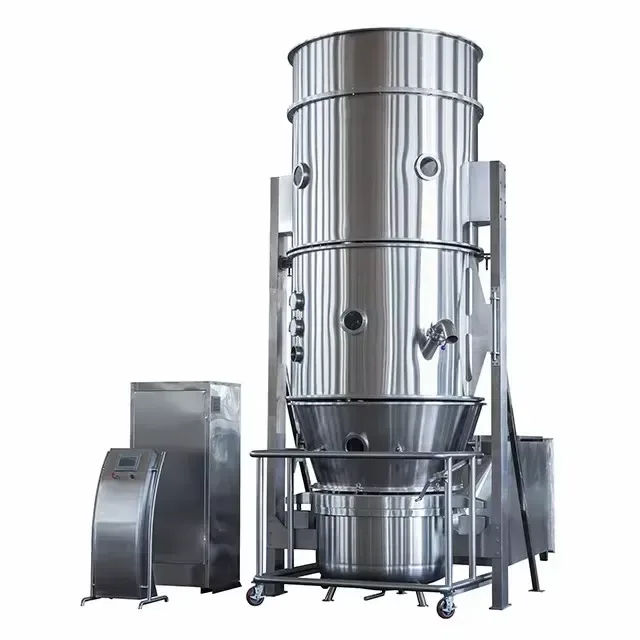
Fluid Bed Granulator — One-Step Granulation and Drying
FL fluid bed granulator mixes, granulates and dries in one closed chamber, giving porous, free-flowing granules. Nine models, 12–1500 L.
The FL fluid bed granulator carries out mixing, granulation and drying in a single closed chamber, which is why it is also called a one-step granulator. Powder is fluidised by filtered hot air while a binder solution is sprayed in from above, building uniform, porous, free-flowing granules that are then dried in place.
Nine models cover 12 to 1500 L container capacity, from 1.5 kg development batches to 750 kg production batches.
One chamber, three operations
In a conventional wet granulation line the product moves between machines: mix, granulate, transfer, dry, transfer again. Each transfer costs time, generates dust and loses material.
The fluid bed granulator collapses that into one closed vessel:
- Mixing. Air fluidises the powder charge into a circulating bed — the powders blend before any liquid is added.
- Granulation. A binder solution is sprayed from above onto the fluidised particles. Droplets bridge particles together, the bridges solidify as drying continues, and granules grow.
- Drying. The spray stops; fluidisation continues until the granules reach target moisture.
- Discharge from the same chamber.
Material yield is ≥99% because the product never leaves the vessel between steps. The operation is closed and low in dust, which matters for GMP production and for handling actives that should not be exposed.
Why top spray builds granules
The nozzle sits above the bed, spraying downward against the rising air. Droplets and particles travel toward each other, and a droplet covers a relatively long path before it reaches a particle — losing some solvent on the way.
That partial drying is what makes granulation work. A droplet arriving partly dried is tacky rather than fluid, so it bridges particles together instead of spreading over them. Repeated across the bed, liquid bridges form, solidify, and the particles grow into porous agglomerates.
Those pores are the reason fluid bed granules compress well: a porous granule deforms and interlocks under compaction where a dense one resists. Where the product is destined for tableting, that matters.
The same counter-current path works against film coating — a droplet that dries before landing cannot spread into a continuous film. For coating, the nozzle moves to the bottom. See top spray vs bottom spray (Wurster) for the full comparison.
The variable that decides the batch
Everything in fluid bed granulation comes back to one balance: spray rate against drying rate.
- Spray faster than the bed can dry, and moisture accumulates. The bed becomes heavy, fluidisation collapses, and the batch is lost as a wet mass on the distributor plate.
- Dry too aggressively, and droplets evaporate before they can bridge particles. Granules stay fine and never grow.
Product temperature is the practical indicator that the balance is holding. It sits between the inlet air temperature and the wet-bulb temperature of the exhaust, and a drift signals the balance is shifting before the bed shows it.
Inlet temperature, air volume, spray rate, atomising pressure and nozzle height all feed into that balance. The settings are established by trials on the actual formulation — values from another product are a starting point for development, not a recipe.
Features
- Mixing, granulation and drying in one closed step
- Uniform, porous, free-flowing granules with good compressibility
- Closed operation, GMP-compliant and low in dust
- Material yield ≥99%
- Fast and labour-saving
- Automatic control of air temperature and spray rate
- Temperature adjustable from ambient to 120 °C
- Interchangeable inserts — the same base unit takes top spray, Wurster and tangential rotor configurations
Technical specifications
| Model | Container capacity (L) | Container diameter (mm) | Batch min (kg) | Batch max (kg) | Air volume (m³/h) | Fan pressure (mmH₂O) | Power (kW) | Steam (kg/h) | Compressed air (m³/min) | Weight (kg) | Dimensions L×W×H (m) |
|---|---|---|---|---|---|---|---|---|---|---|---|
| FL-3 | 12 | 300 | 1.5 | 4.5 | 1000 | 375 | 3 | 15 | 0.9 | 500 | 1.0×0.6×2.1 |
| FL-5 | 22 | 400 | 4 | 6 | 1200 | 375 | 4 | 23 | 0.9 | 700 | 1.2×0.7×2.1 |
| FL-15 | 45 | 550 | 10 | 20 | 1400 | 480 | 5.5 | 42 | 0.9 | 900 | 1.25×0.9×2.5 |
| FL-30 | 100 | 700 | 15 | 45 | 1800 | 480 | 7.5 | 70 | 0.9 | 1000 | 1.6×1.1×2.5 |
| FL-60 | 220 | 1000 | 30 | 90 | 3000 | 950 | 11 | 141 | 1.0 | 1100 | 1.85×1.4×3 |
| FL-120 | 420 | 1200 | 80 | 160 | 4500 | 950 | 18.5 | 211 | 1.0 | 1300 | 2.2×1.65×3.3 |
| FL-200 | 670 | 1400 | 100 | 300 | 6000 | 950 | 22 | 282 | 1.1 | 1500 | 2.34×1.7×3.8 |
| FL-300 | 1000 | 1600 | 150 | 450 | 7000 | 950 | 30 | 366 | 1.5 | 1800 | 2.8×2.0×4.0 |
| FL-500 | 1500 | 1800 | 250 | 750 | 8000 | 950 | 45 | 451 | 1.5 | 2000 | 3×2.25×4.4 |
Common to all models: steam pressure 0.3–0.6 MPa · temperature adjustable ambient to 120 °C · operating time 45–90 min depending on material · material yield ≥99% · noise ≤75 dB(A) with the fan installed separately from the main unit.
Each model has a minimum and a maximum batch because what fills the container is volume, not weight. A low-bulk-density powder reaches the working volume at a much lower charge weight than a dense one, and the bed needs headroom above the charge to expand and circulate. Confirm the figure against your own material.
Operating time is stated as a range for the same reason — a formulation that granulates and dries quickly finishes near 45 minutes, one that needs a gentler profile runs closer to 90.
Applications
Granules for tableting and capsules in the pharmaceutical, food and chemical industries — particularly where the granules will be compressed and compressibility matters, or where combining granulation and drying in one machine simplifies the line.
Fluid bed or high shear?
| Fluid bed (FL) | High shear | |
|---|---|---|
| Granule structure | Porous, lighter | Dense, strong |
| Compressibility | Higher | Lower |
| Bulk density | Lower | Higher |
| Drying | Same chamber | Separate step |
| Cycle time | Longer | Short |
| Process control | Gradual, easier to hold | End point is narrow and critical |
| Footprint | One machine | Granulator plus dryer |
Choose fluid bed where compressibility matters more than density, where the material is shear-sensitive, where dust containment is important, or where one machine instead of two suits the line.
Choose high shear where the tablet needs robust dense granules, where drug loading is high, or where cycle time drives throughput.
Consider a dry route where the formulation is moisture- or heat-sensitive. A dry roller compaction granulator granulates without liquid or heat at all.
Selecting a model
| Input | Why it matters |
|---|---|
| Batch size range and bulk density | Selects container volume — density decides what it holds |
| Formulation and binder system | Determines spray rate, cycle time and granule growth |
| Target granule size and moisture | Defines the process end point and acceptance criteria |
| Heat sensitivity of the actives | Sets the usable inlet temperature range |
| Downstream process | Compression, capsule filling or coating imply different granules |
| Available utilities | Steam capacity and air volume constrain the model as much as batch size |
| GMP and containment requirements | Determines contact materials, finish, filters, cleaning design and records |
Request a configuration
Send us the formulation, bulk density, batch size range, heat sensitivity and what happens downstream. We will size the FL against your process and advise on the insert configuration — and where a high-shear or dry route suits the product better, we will say so.
Technical Specifications
| Model | 3 | 5 | 15 | 30 | 60 | 120 | 200 | 300 | 500 |
|---|---|---|---|---|---|---|---|---|---|
| Material Container Capacity (L) | 12 | 22 | 45 | 100 | 220 | 420 | 670 | 1000 | 1500 |
| Material Container Diameter (mm) | 300 | 400 | 550 | 700 | 1000 | 1200 | 1400 | 1600 | 1800 |
| Production Capacity, Min (kg) | 1.5 | 4 | 10 | 15 | 30 | 80 | 100 | 150 | 250 |
| Production Capacity, Max (kg) | 4.5 | 6 | 20 | 45 | 90 | 160 | 300 | 450 | 750 |
| Fan Air Volume (m³/h) | 1000 | 1200 | 1400 | 1800 | 3000 | 4500 | 6000 | 7000 | 8000 |
| Fan Pressure (mmH2O) | 375 | 375 | 480 | 480 | 950 | 950 | 950 | 950 | 950 |
| Power (kW) | 3 | 4 | 5.5 | 7.5 | 11 | 18.5 | 22 | 30 | 45 |
| Steam Consumption (kg/h) | 15 | 23 | 42 | 70 | 141 | 211 | 282 | 366 | 451 |
| Compressed Air Consumption (m³/min) | 0.9 | 0.9 | 0.9 | 0.9 | 1.0 | 1.0 | 1.1 | 1.5 | 1.5 |
| Main Unit Weight (kg) | 500 | 700 | 900 | 1000 | 1100 | 1300 | 1500 | 1800 | 2000 |
| Steam Pressure (MPa) | 0.3–0.6 | 0.3–0.6 | 0.3–0.6 | 0.3–0.6 | 0.3–0.6 | 0.3–0.6 | 0.3–0.6 | 0.3–0.6 | 0.3–0.6 |
| Temperature (℃) | Ambient–120 | Ambient–120 | Ambient–120 | Ambient–120 | Ambient–120 | Ambient–120 | Ambient–120 | Ambient–120 | Ambient–120 |
| Operating Time (min) | 45–90 | 45–90 | 45–90 | 45–90 | 45–90 | 45–90 | 45–90 | 45–90 | 45–90 |
| Material Yield (%) | ≥99 | ≥99 | ≥99 | ≥99 | ≥99 | ≥99 | ≥99 | ≥99 | ≥99 |
| Noise (dB(A)) | ≤75 | ≤75 | ≤75 | ≤75 | ≤75 | ≤75 | ≤75 | ≤75 | ≤75 |
| Main Unit Dimensions L×W×H (m) | 1.0×0.6×2.1 | 1.2×0.7×2.1 | 1.25×0.9×2.5 | 1.6×1.1×2.5 | 1.85×1.4×3 | 2.2×1.65×3.3 | 2.34×1.7×3.8 | 2.8×2.0×4.0 | 3×2.25×4.4 |
Frequently Asked Questions
Related Products
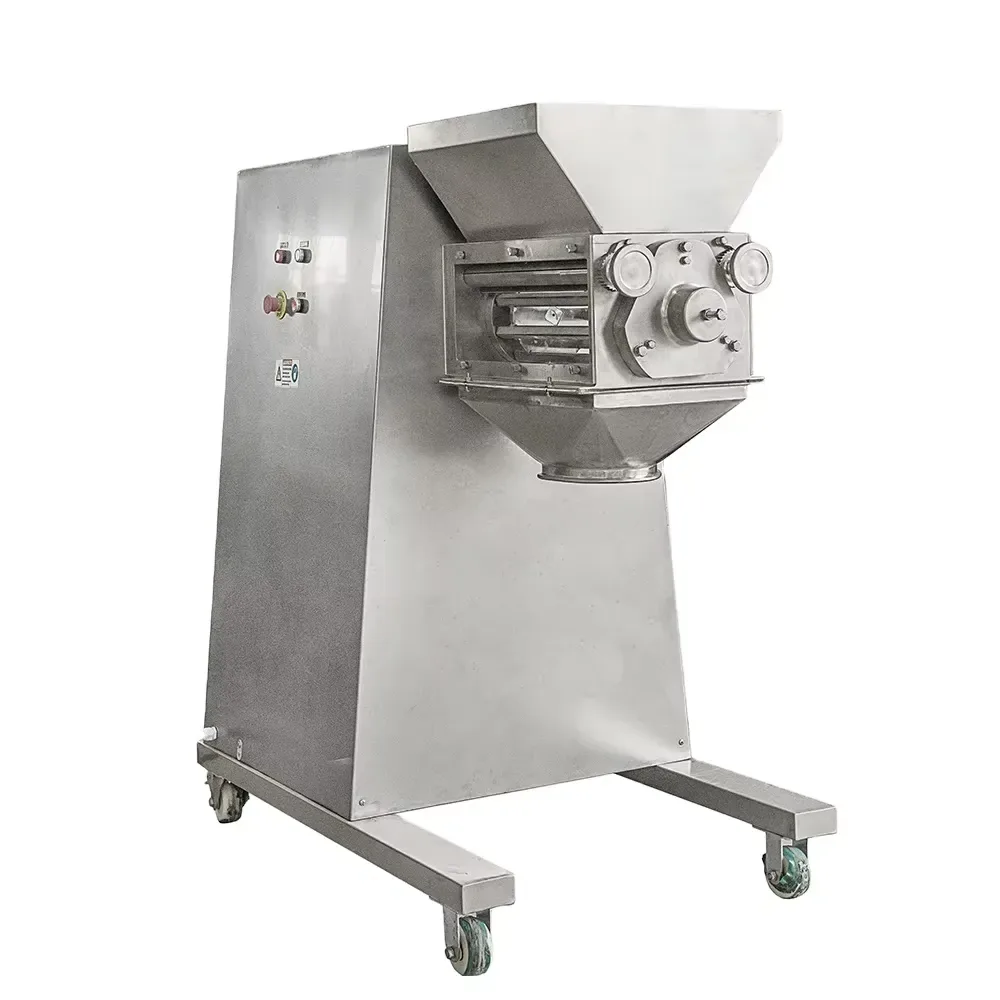
Oscillating Granulator
Oscillating granulator that forms wet powders into uniform granules by pressing them through a screen with an oscillating roller.
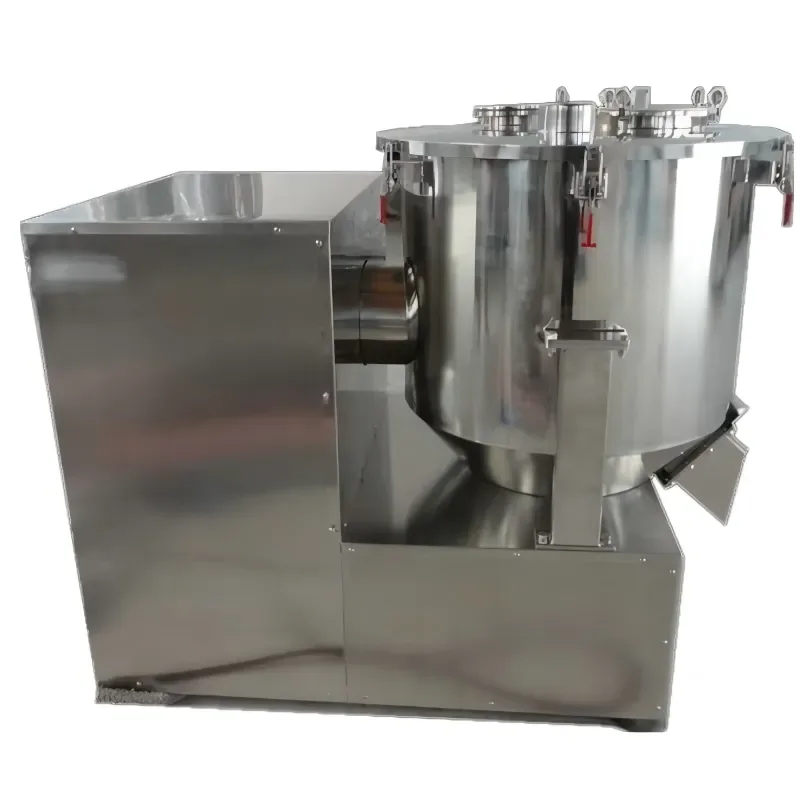
High-Shear Wet Granulator (RMG) for Pharma Granulation
GHL high-shear wet granulator — rapid mixer granulator with impeller and chopper producing dense, uniform granules in one closed vessel. Eight models, 10–600 L.
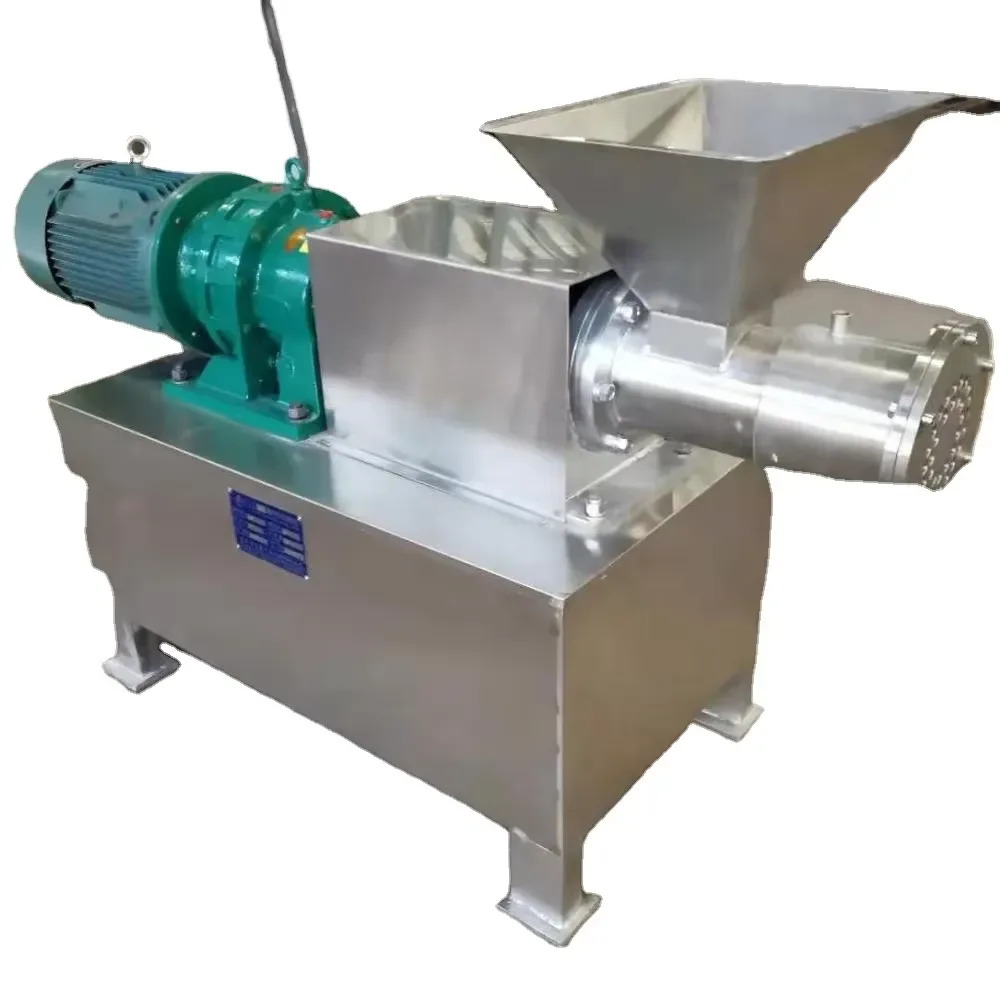
Roller Compactor — Dry Granulation Without Liquid or Heat
GFZL roller compactor for dry granulation of moisture- and heat-sensitive powders. No binder, no drying step. Five models, 80–2000 kg/h finished granules.
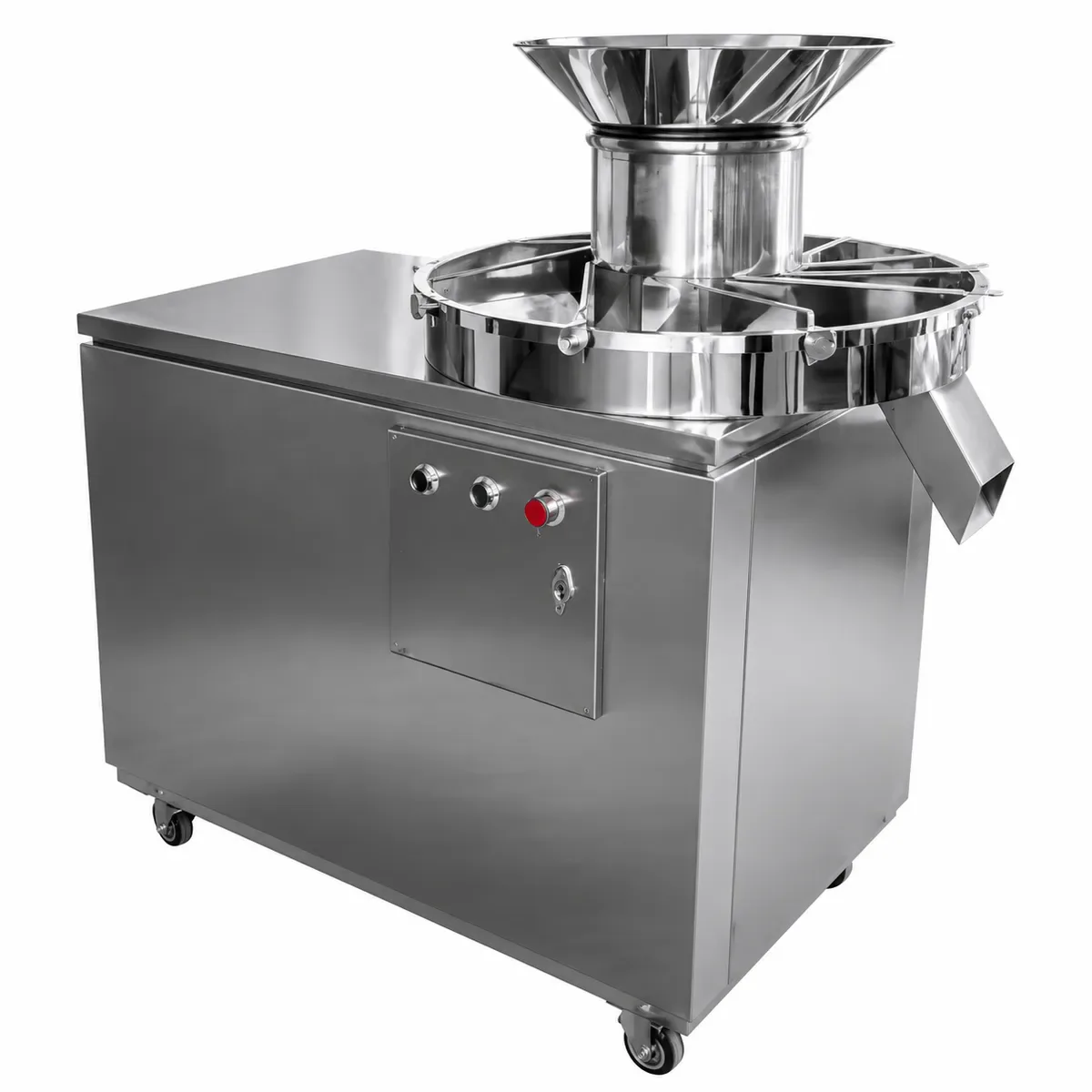
Rotary Granulator
Rotary granulator with a rotating cutter that presses mixed material through a screen into neat granules, ideal for highly viscous materials.
Product Categories
Start Optimizing Your Drying Process Today
Contact our experts for pricing, customization options, and technical support for Fluid Bed Granulator — One-Step Granulation and Drying.