
Top Spray vs Bottom Spray (Wurster) in a Fluid Bed
Two fluid bed machines can look almost identical from outside and produce completely different results. The difference is usually where the nozzle sits.
Nozzle position decides the direction droplets travel relative to the particles, how far a droplet flies before it lands, and how much it dries on the way. Those three things determine whether the process builds granules or lays down a film.
The core difference
| Top spray | Bottom spray (Wurster) | |
|---|---|---|
| Nozzle position | Above the bed, spraying down | At the base, spraying up through a partition |
| Droplet vs particle direction | Counter-current — they meet head on | Concurrent — they travel together |
| Distance before contact | Longer | Short |
| Drying during flight | More | Less |
| Typical purpose | Granulation, agglomeration | Film coating, layering |
| Typical result | Porous, irregular agglomerates | Continuous, even film |
Everything below follows from that table.
Why top spray builds granules
In a top spray arrangement the nozzle sprays downward while the fluidising air carries particles upward. Droplets and particles meet head on, and a droplet travels a relatively long path before it reaches a particle — losing some solvent on the way.
That partial drying is not a defect. A droplet that arrives partly dried is tacky rather than fluid, so it bridges particles together instead of spreading over them. Repeated across the bed, this is exactly what granulation needs: liquid bridges form, solidify as drying continues, and the particles grow into agglomerates.
The result is a porous granule with good compressibility — useful where the granules are later compressed into tablets. A fluid bed granulator works this way, mixing, granulating and drying in one closed chamber rather than moving material between separate machines.
The same counter-current path that helps granulation works against coating. A droplet that dries before it lands cannot spread into a continuous film. Some coating applications still use top spray — hot melt coating and simple taste masking among them — but a demanding film specification usually points elsewhere.
Why bottom spray coats evenly
The Wurster configuration is named after Dale Wurster, who developed it at the University of Wisconsin in the 1950s. A partition column inside the product container divides the bed into two regions.
The cycle runs like this:
- Air velocity is highest inside the partition, so particles accelerate up through it.
- The nozzle sits at the base of the partition, spraying upward — the same direction the particles are already moving.
- Because droplet and particle travel together over a short distance, the droplet is still wet when it lands, and spreads.
- Above the partition the air expands, the particles slow and fall back down outside it, drying as they go.
- They re-enter at the bottom and pass the nozzle again.
Each particle therefore crosses the spray zone many times, receiving a thin layer each pass. That repetition — not a single heavy application — is what produces an even film.
This matters wherever the coating has a functional job rather than a cosmetic one: controlled or sustained release, enteric protection, moisture barriers, taste masking. A fluid bed coater using bottom spray is built for that kind of work.
A third option: tangential spray
A third arrangement mounts the nozzle tangentially and adds a rotating disc at the base of the product container. The disc introduces mechanical movement the other two configurations do not have, so particles follow a spiralling path — rotating, rising and falling — as they pass the nozzle.
That mechanical action densifies as it coats. It suits layering, where particles are built up from a starter core, and high coating loads that would take an impractical number of passes in a Wurster. It is a specialised configuration rather than a default, and worth assessing when the product form calls for it.
Zhengyuan supplies the tangential rotor arrangement alongside top spray and Wurster. Which one belongs in your line follows from the product, not from the machine.
Choosing between them
Start with the product you need, not the machine:
Choose top spray when
- the goal is granule growth rather than a surface layer
- granules will be compressed downstream and need porosity
- the material tolerates the thermal and mechanical conditions of fluid bed granulation
Choose bottom spray (Wurster) when
- the coating has a functional specification — release profile, protection, taste masking
- film uniformity and completeness matter
- the substrate is granules, pellets or small particles that can be fluidised in a partition
Look at other equipment when
- the formulation needs high-shear wetting and densification, which points to a high-shear wet granulator rather than a fluid bed
- the target is dense, spherical pellets, which normally involves extrusion followed by a spheronizer
- the material is moisture-sensitive or heat-sensitive enough that a wet route is unsuitable
What determines whether it works
Nozzle position sets the process type. These decide whether it succeeds:
| Variable | Why it matters |
|---|---|
| Inlet air temperature and volume | Controls drying rate against spray rate |
| Spray rate and atomising pressure | Sets droplet size and how wet the bed becomes |
| Nozzle height and partition gap | Governs particle circulation through the spray zone |
| Product temperature | The practical indicator of whether the balance holds |
| Binder or polymer system | Determines viscosity, tack and film formation |
| Substrate size and density | Determines whether the material fluidises in a stable pattern |
| Batch size and fill level | Affects circulation pattern and cycle time |
The balance between spray rate and drying rate is the one to watch. Spray too fast for the drying conditions and the bed over-wets and collapses. Dry too aggressively and the coating goes on rough and incomplete, or granules stay fine and never grow.
These settings are established by trials on the actual formulation. Values taken from a different product, or from a machine of a different size, are a starting point for development work — not a recipe.
Scale-up
A process developed on a laboratory unit does not transfer to production by scaling numbers proportionally. Air volume, spray rate, nozzle count and partition geometry all change, and the relationships between them are not linear.
Plan for trials at each scale and record the process conditions that produced acceptable product, together with the quality results used to judge it.
Talk to Zhengyuan
Tell us the substrate, the target product form, the coating or granule specification and your batch size range. Our fluid bed systems take interchangeable top spray, Wurster and tangential rotor inserts, so the configuration follows your process rather than the other way round — and where one convertible unit is the wrong answer for your production pattern, we will tell you that instead of selling you one.
Frequently Asked Questions
Related Products
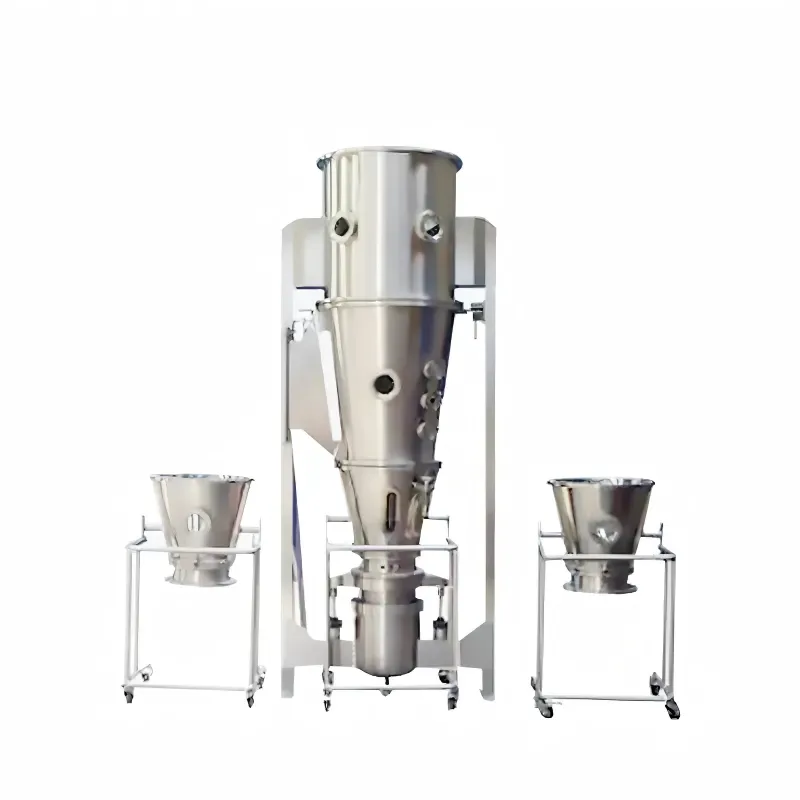
Wurster Fluid Bed Coater — Bottom Spray Film Coating
Bottom-spray (Wurster) fluid bed coater for uniform film coating of powders, granules and pellets. Batch 4–250 kg, container 15–650 L.
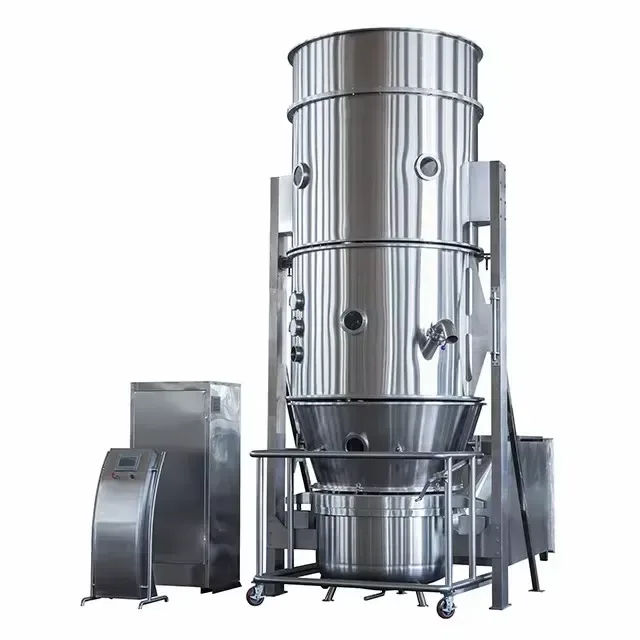
Fluid Bed Granulator — One-Step Granulation and Drying
FL fluid bed granulator mixes, granulates and dries in one closed chamber, giving porous, free-flowing granules. Nine models, 12–1500 L.
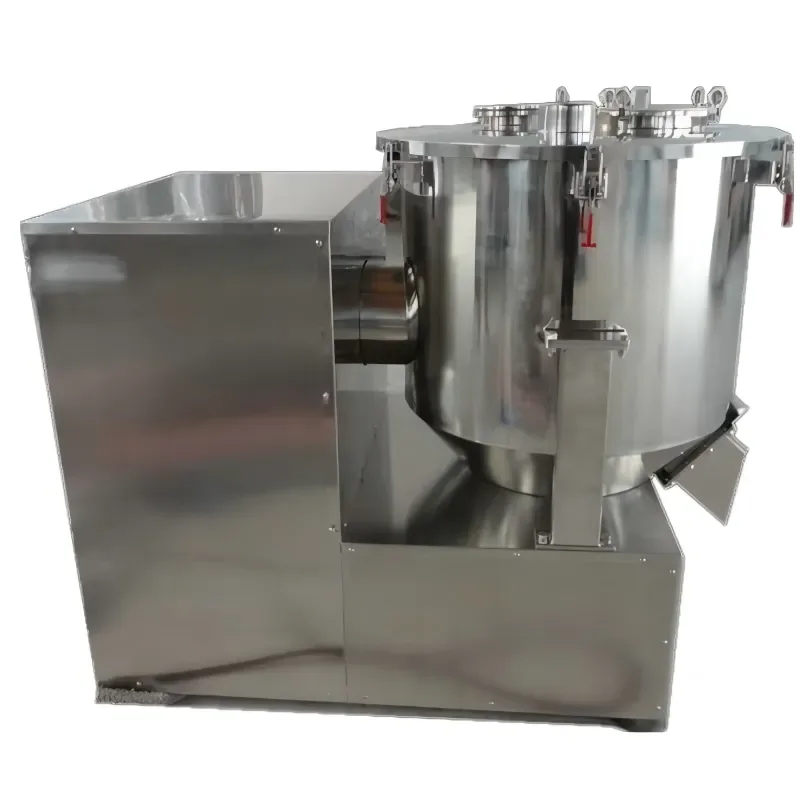
High-Shear Wet Granulator (RMG) for Pharma Granulation
GHL high-shear wet granulator — rapid mixer granulator with impeller and chopper producing dense, uniform granules in one closed vessel. Eight models, 10–600 L.
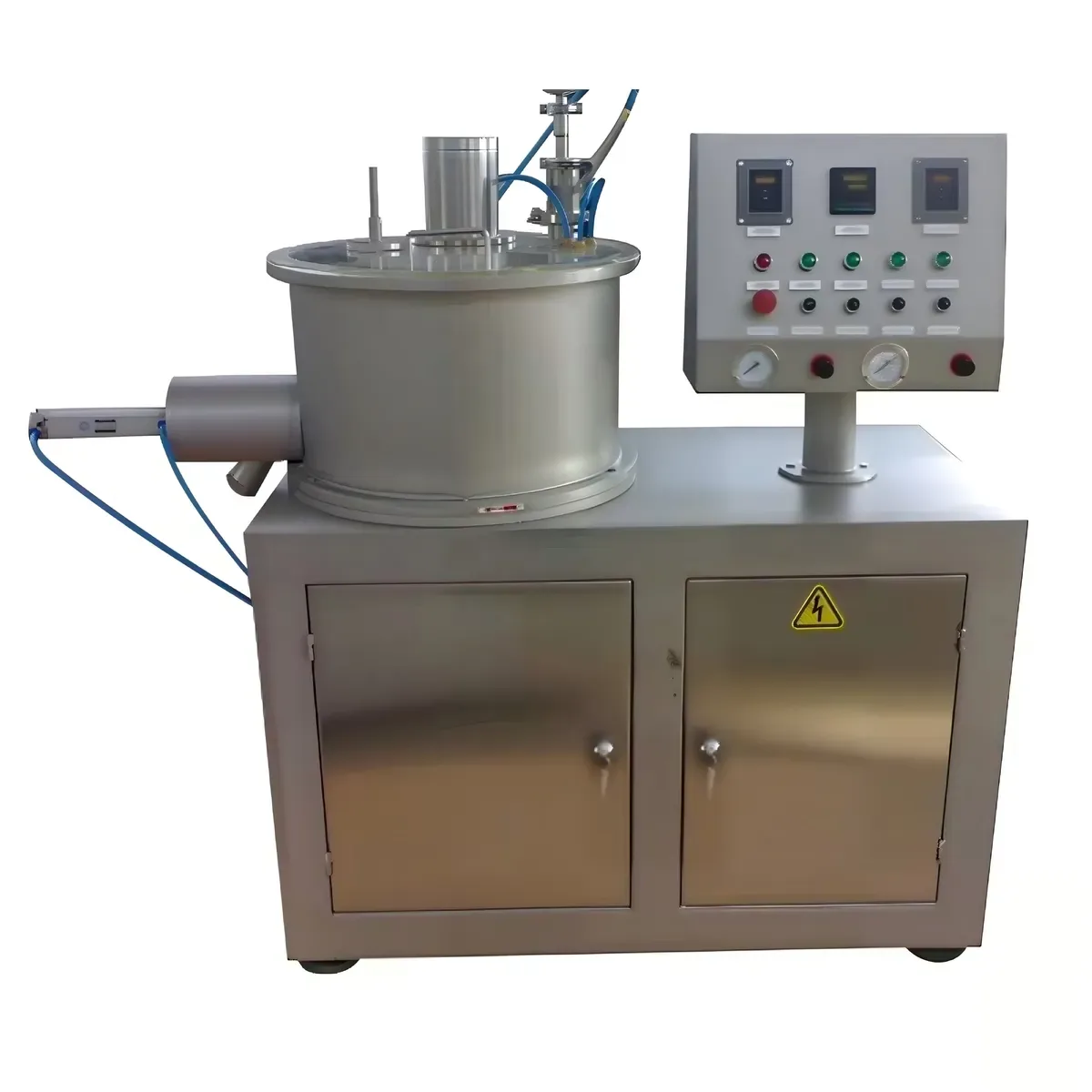
Spheronizer — Extrusion Spheronization for Pellets
QZL spheronizer rounds wet extrudate into spherical 0.5–2.0 mm pellets for capsule filling and coating. Six models, 2.5–300 kg/h.