
Spray Dryer Components & Structure
A spray dryer is a system of components that work together to atomize a liquid, dry it and recover the powder. Understanding each part explains both the strengths of spray drying and its trade-offs.
Atomizer
The atomizer disperses the liquid into fine droplets to multiply its surface area. It is the heart of the machine — centrifugal, pressure or two-fluid — and its choice sets particle size and which feeds the dryer can handle (see spray dryer types).
Air distributor
The air distributor shapes how hot air enters the drying chamber, and it does more than it appears:
- Even air distribution — feeds hot air into the chamber at a uniform velocity and flow, avoiding local hot or cold spots.
- Better heat transfer — optimises the airflow path so droplets and hot air get more contact area and time, raising drying rate and lowering energy use.
- Prevents wall- and roof-sticking — steers the airflow to reduce contact between sticky material and the chamber surfaces.
- Improves powder flow — creates an even flow field so powder moves uniformly, reducing adhesion and agglomeration.
- Adapts to the material — for oxidisable or heat-sensitive feeds, its structure and parameters can be tuned to lower air temperature and velocity.
Drying chamber
The chamber is where droplets meet hot air and dry in seconds. A good design uses a three-section body, often with a vibration device to reduce wall-sticking, and a cold-air jacket that brings the finished powder below 40°C. Contact surfaces are stainless steel, or high-borosilicate glass on laboratory units for visibility and corrosion resistance.
Hot-air system
This provides clean, evenly heated air — typically an air filter, pre-heater and blower. Heating can be electric (±1°C control), steam or thermal oil, and PID control holds the inlet (140–350°C) and outlet (80–90°C) temperatures precisely.
Separation and collection
- Cyclone separator — recovers most of the powder by centrifugal force, at about ≥95% efficiency.
- Bag filter — captures the fine dust so the exhaust meets emission limits.
Control system
A PLC and touchscreen monitor inlet and outlet temperature and feed-pump speed in real time, with fault self-diagnosis, over-heat protection and pressure control for safe, repeatable operation.
Honest trade-offs
Spray dryers are large and represent a significant upfront investment, and their thermal efficiency is typically 30–50%, so running cost matters. In return they run continuously at scale, dry in seconds, and give a uniform, soluble, high-purity powder. Where energy is a concern, heat recovery and multi-stage drying help.
Figures are industry-typical; verify against your equipment before relying on them.
Frequently Asked Questions
Related Products
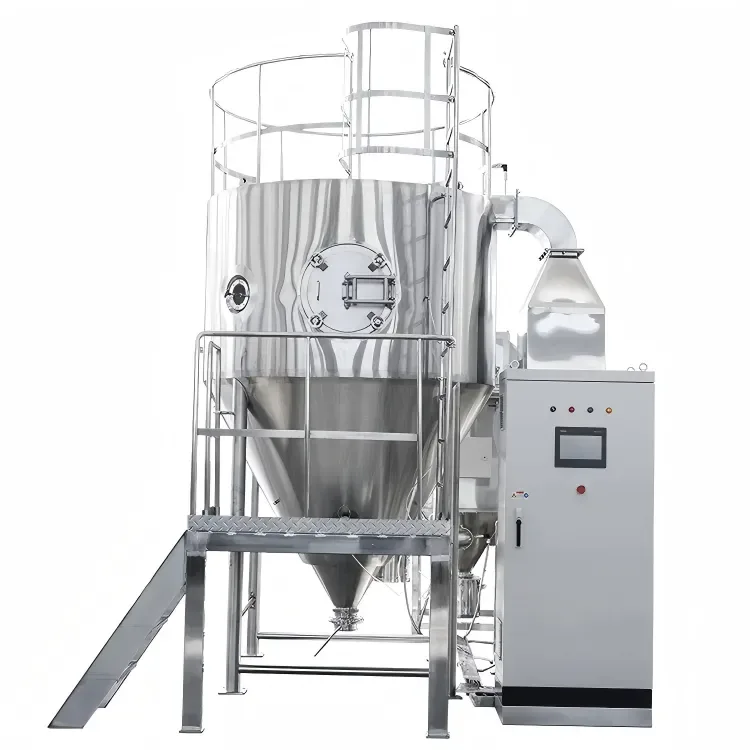
High-Speed Centrifugal Spray Dryer
Centrifugal spray dryer turning solutions, suspensions, emulsions and pastes into powder in one pass. Models from 5 to 2,000 kg/h water evaporation.
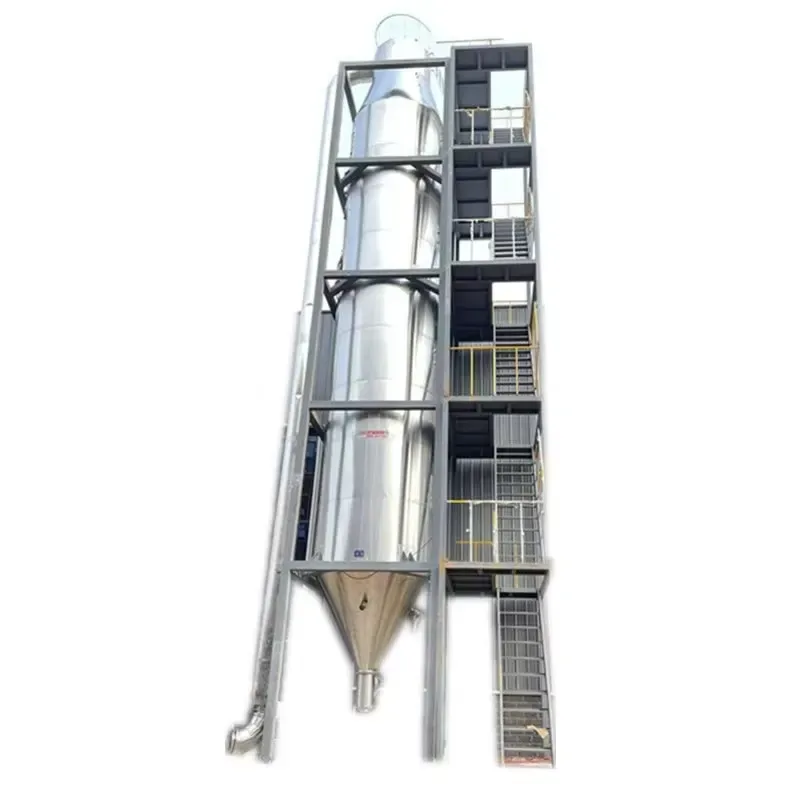
Pressure Spray Dryer
Pressure-nozzle spray dryer that dries and granulates in one step, producing uniform spherical granules with good flow and solubility.