
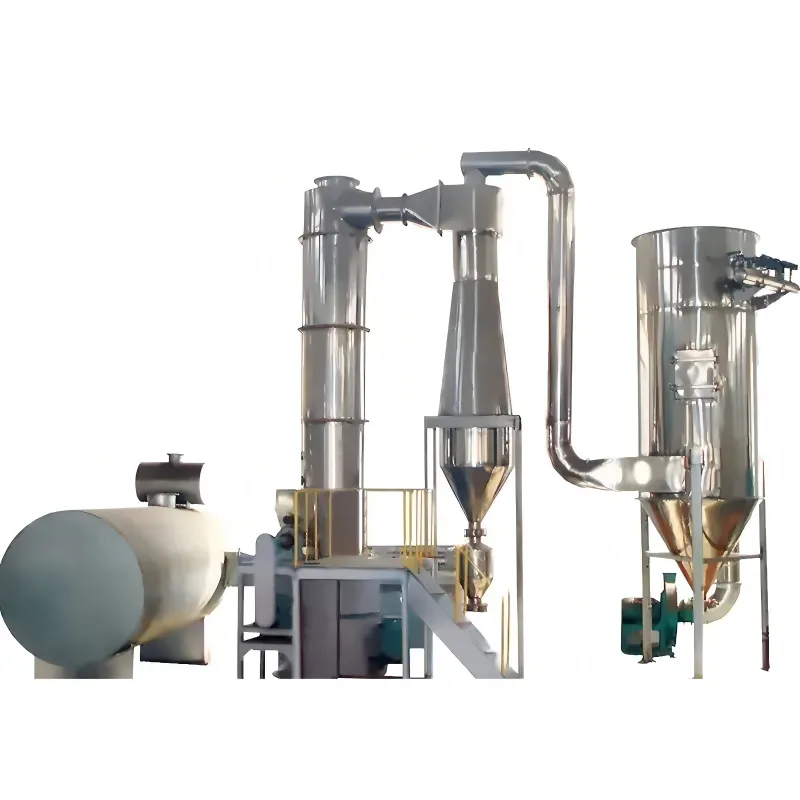
Spin Flash Dryer
XSG spin flash dryer for filter cakes, pastes and slurries. Dries, disintegrates and classifies in one chamber. Seven models evaporating 58–1,203 kg/h of water.
The XSG spin flash dryer turns wet filter cake, paste or slurry into dry, free-flowing powder in a single pass that takes seconds. Drying, disintegration and classification all happen inside one vertical chamber, so there is no separate mill downstream and no intermediate handling of half-dried material.
Seven models evaporate 58 to 1,203 kg of water per hour, on chamber diameters from 400 to 1,600 mm.
What it dries
The machine is built for feeds that are too wet, too sticky or too lumpy to fluidise on their own — filter cakes above all, then pastes and thick slurries. Materials it is routinely specified for:
- Inorganic chemicals — calcium carbonate, iron oxide, kaolin, bentonite, zinc sulfate, white carbon black
- Organic chemicals — catalysts, dye intermediates such as H-acid and DSD-acid, pesticide raw materials, resins
- Minerals — kaolin, talc, mica, alumina, zinc oxide
- Pigments — titanium dioxide, iron oxide red, phthalocyanine blue and green
- Food — starch, soy protein, collagen, whey
- Pharmaceutical — herbal extracts, antibiotics, vitamins, berberine
- New energy and nano — LFP cathode material, graphene, nano zinc oxide, nano silica
If your material dissolves rather than filters, or arrives as a pumpable low-viscosity liquid, a spray dryer is the better route. Free-flowing granules that only need surface moisture removed belong in a fluid bed dryer.
What you set on the machine
Three things are adjustable, and between them they determine what comes out:
- Agitator speed. A multi-blade scraper agitator at the base shears the incoming cake apart. Its speed is set to the feed — enough to disintegrate lumps, not so much that a fragile product is over-milled. Scrapers at the blade tips keep the wall clear.
- Classifier ring and swirl vanes. These sit at the top and decide what is allowed to leave. Changing the ring diameter and section height changes the gas velocity there, so both particle size and final moisture are set here. Under-dried or oversized particles fall back for another pass.
- Bottom cooling. A cold-air jacket in the hot bottom zone lowers local wall temperature, which is what makes the machine usable for heat-sensitive products despite the high inlet temperature.
The whole system runs closed and at slight negative pressure, with cyclone and bag filter giving gas–solid separation of at least 99 percent, so dust does not escape into the workshop.
Selecting a model
Size the dryer on the water you must remove per hour, not on finished product throughput. Two plants making the same tonnage need very different machines if one feed enters at 40 percent moisture and the other at 15 percent.
Work out your evaporation duty, then read the Water Evaporation row of the specification table on this page and take the model that covers it. Leave margin for the wettest feed you realistically expect, not the average — a dryer sized on average moisture runs out of capacity exactly when the upstream filter has a bad day.
If your particle-size specification is tight, say so at the enquiry stage so the classifier is specified for it rather than retrofitted.
Configuring it to your material
Two choices do most of the work, and both belong in the enquiry rather than after the order:
| Decision | Options | What decides it |
|---|---|---|
| Feed device | Single-screw, twin-screw, twin-paddle mixer, feed box with integral crusher, volumetric feeder, rotary star feeder | How sticky and how lumpy the cake is. The twin-paddle mixer back-mixes dried product into the wet feed to bring stickiness down |
| Heat source | Direct or indirect combustion heater on gas or liquid fuel; solid-fuel furnace on coal, sawdust, rice husk or biomass; indirect steam or thermal oil; electric | Fuel available on site, the inlet temperature you need, and whether the product may touch combustion gas at all |
Bridging at the feed point is the most common cause of unstable running on difficult cakes, which is why the feeder is chosen against the material rather than supplied as a default.
A limitation to plan for
The hidden risk in any flash dryer is not the dryer — it is the hot-air furnace. If a furnace weld cracks, flue gas carrying sparks can enter the drying air, and for an organic powder in a fast-moving air stream that is a serious matter.
For heat-sensitive organics and anything flammable, the answer is to keep combustion gas out of the drying air completely:
- Indirect heating, or flue-gas isolation, so combustion gas and sparks never reach the material
- Explosion-proof motors and anti-static design on flammable feeds
- Closed-loop operation under nitrogen where oxidation or flammability is a real concern
This costs more than direct firing and it is the right decision for dye intermediates, fine-chemical actives and organic flame retardants. We would rather discuss it while sizing the machine than have it come up during commissioning.
Features
- Drying, crushing and classification in one unit — no separate mill
- Residence time of seconds, so heat-sensitive products are not held at temperature
- Adjustable classifier for controlled particle size and final moisture
- Cooling device at the base protects against local heat degradation
- Air-seal and bearing-cooling devices extend drive service life
- Closed, slightly negative-pressure operation with ≥99 percent separation — no dust emission
- Feeders available for pastes and filter cakes that would bridge in a plain screw
Request a configuration
Send these and we can size the machine and quote a configuration rather than a price for a bare model:
- The material, and whether it arrives as filter cake, paste or slurry
- Inlet and target outlet moisture, as percentages
- Throughput — wet feed per hour, or finished product per hour
- Particle-size requirement, if there is one
- Whether the product may contact combustion gas
- Materials of construction or compliance requirements — stainless grade, GMP, ATEX
Related reading: how a spin flash dryer works covers the process and chamber structure in detail, and how to choose a flash dryer walks through sizing, materials of construction and supplier checks.
Technical Specifications
| Model | XSG-4 | XSG-6 | XSG-8 | XSG-10 | XSG-12 | XSG-14 | XSG-16 |
|---|---|---|---|---|---|---|---|
| Main Unit Inner Diameter (mm) | 400 | 600 | 800 | 1000 | 1200 | 1400 | 1600 |
| Air Flow (m³/h) | 1150-2300 | 2500-5100 | 4500-9000 | 7000-13500 | 10000-20000 | 16600-28000 | 18000-38100 |
| Water Evaporation (kg/h) | 58-73 | 130-163 | 238-297 | 345-430 | 515-645 | 730-910 | 962-1203 |
| Max Installed Capacity (kW) | 21.4 | 34.2 | 63.5 | 68 | 94 | 130 | 160 |
| Max Height (m) | 4.6 | 5.5 | 6.0 | 6.5 | 6.8 | 7.0 | 7.2 |
| Floor Area (m²) | 27 | 39 | 40 | 55 | 62 | 89 | 160 |
Frequently Asked Questions
Product Categories
Start Optimizing Your Drying Process Today
Contact our experts for pricing, customization options, and technical support for Spin Flash Dryer.