
How a Spin Flash Dryer Works: Process, Structure and Key Parameters
A spin (rotary) flash dryer turns wet filter cakes, pastes and slurries into a free-flowing powder in a single pass that takes only a few seconds. It does this by combining three things in one cylindrical chamber: mechanical disintegration, a high-speed rotating hot-air field, and built-in size classification. The result is a dryer that handles high-moisture, high-viscosity and heat-sensitive materials that would scorch or cake in a conventional dryer.
This guide explains the working process step by step, then walks through the chamber structure that makes it possible.
The drying process in five steps
1. Tangential air entry creates a rotating flow field. Hot air enters the bottom of the chamber tangentially at high speed. Driven by a high-speed agitator, it forms a strong swirling, turbulent field that fills the whole drying section.
2. Feed enters and is disintegrated. Wet material — usually a filter cake or paste — is metered into the bottom of the chamber by a screw feeder. The agitator's impact, friction and shear break the lumps into fine particles and disperse them into the hot air stream, so every particle is exposed to heat.
3. Instant heat exchange dries the particles. The dispersed particles make intimate contact with the hot air and the moisture flashes off almost immediately. Because residence time in the chamber is only 1–5 seconds, drying is extremely fast and the material never dwells long enough to overheat.
4. A classifier holds back wet particles. Drier particles are carried upward by the swirling gas. At the classifier ring near the top, larger particles that are not yet dry are thrown outward by centrifugal force, fall back to the bottom, and are disintegrated and dried again. Only particles that meet the target size and moisture pass through the center of the ring.
5. Product is collected and the exhaust is cleaned. On-spec powder leaves through the classifier and passes to a cyclone and bag filter for gas–solid separation. The dry product is collected, and the cleaned exhaust is vented. Separation efficiency is typically ≥99%, and the closed, slightly negative-pressure system keeps dust contained.
The core logic: mechanical disintegration plus an intensified rotating flow field gives instant drying of high-moisture, high-viscosity materials, while the classification loop keeps moisture and particle size uniform.
The chamber structure: three sections in one cylinder
The body is a vertical cylinder split into three functional zones — crushing/fluidizing at the bottom, drying in the middle, and classifying at the top — so disintegration, drying and sizing all happen in one machine.
Bottom: crushing and fluidizing section
- Inverted-cone base. The cross-section widens from bottom to top, creating a gas-velocity gradient that keeps both large and small particles well fluidized and prevents material from settling. It also shortens the agitator-shaft overhang, improving reliability.
- Scraper-type agitator. A multi-blade agitator spins at an adjustable speed to shear and disintegrate the feed. Scrapers at the blade tips peel material off the wall to prevent "scarring" (build-up), keeping operation continuous, and the agitator drives the air into a rising spiral that intensifies heat and mass transfer.
- Cooling provision. A cold-air jacket or cooling device in the hot bottom zone lowers local wall temperature so heat-sensitive materials (food, pharmaceuticals) don't degrade on contact with hot surfaces.
Middle: drying section
- Volute air distributor. A scroll-shaped distribution chamber spreads the tangential hot air evenly through an annular guide gap, forming a stable rotating field. Circumferential gas velocity is high (up to ~30 m/s) and residence time is only seconds — the basis of the "small machine, large output" effect.
- Screw feeder. Ensures viscous pastes and filter cakes enter evenly and gives larger lumps an initial break-up.
Top: classifying section
- Classifier ring and swirl vanes. Adjusting the ring diameter and section height controls gas velocity and particle paths. Under-dried, denser particles whose spiral radius exceeds the ring are held back to dry further; on-spec product exits with the gas — giving precise control of particle size and final moisture.
- Cyclone and bag filter. Gas–solid separation efficiency ≥99%. The system runs closed and at slight negative pressure, so dust does not escape — better for the environment and for operator health.
Other structural features
- Drive protection: air-seal devices and bearing cooling protect bearings from the high-temperature environment, extending service life and cutting maintenance.
- Modular build: chamber diameter and length can be sized to the required throughput.
- Feed options: screw feeders and special feeders suit pastes, filter cakes and other difficult feeds without bridging.
Key parameters by model
The numbers below are for our XSG spin flash dryer line and show how throughput scales with chamber diameter. Water-evaporation capacity is the figure to size against.
| Model | Chamber Ø (mm) | Air flow (m³/h) | Water evaporation (kg/h) | Installed power (kW) | Footprint (m²) |
|---|---|---|---|---|---|
| XSG-4 | 400 | 1,150–2,300 | 58–73 | 21.4 | 27 |
| XSG-6 | 600 | 2,500–5,100 | 130–163 | 34.2 | 39 |
| XSG-8 | 800 | 4,500–9,000 | 238–297 | 63.5 | 40 |
| XSG-10 | 1,000 | 7,000–13,500 | 345–430 | 68 | 55 |
| XSG-12 | 1,200 | 10,000–20,000 | 515–645 | 94 | 62 |
| XSG-14 | 1,400 | 16,600–28,000 | 730–910 | 130 | 89 |
| XSG-16 | 1,600 | 18,000–38,100 | 962–1,203 | 160 | 160 |
Not sure which size you need? See our flash dryer selection guide, or view the full Spin Flash Dryer specifications and the rest of our flash dryer range.
Frequently Asked Questions
Related Products
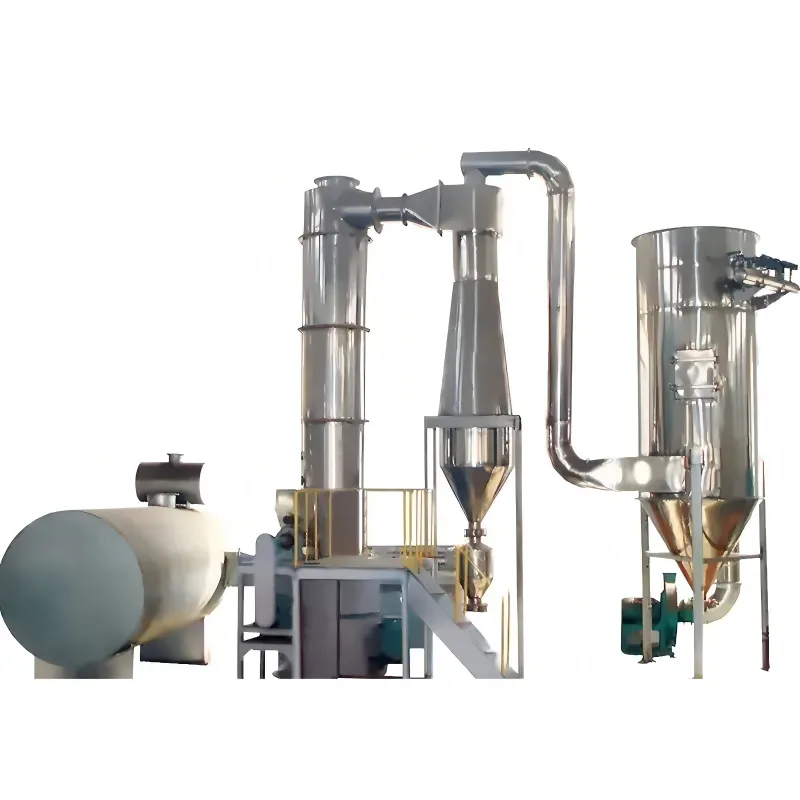
Spin Flash Dryer
XSG spin flash dryer for filter cakes, pastes and slurries. Dries, disintegrates and classifies in one chamber. Seven models evaporating 58–1,203 kg/h of water.
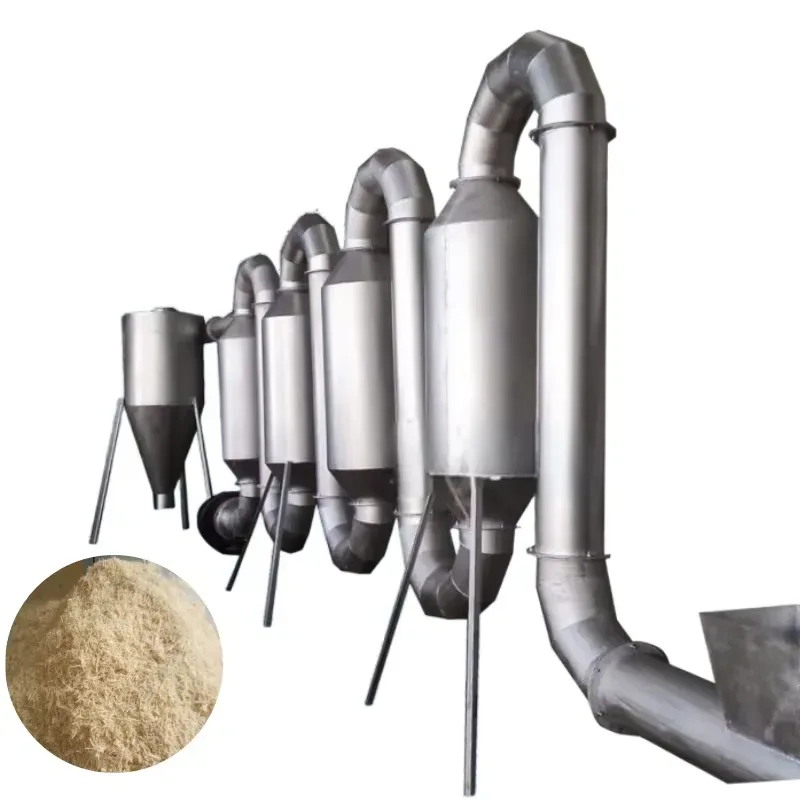
Pulse Flash Dryer
Pulse flash dryer using instantaneous airborne drying to remove free moisture from powders and granules at high throughput.