
How Efficient Is a Flash Dryer? Heat Transfer, Thermal Efficiency and Energy Saving
A spin flash dryer is one of the most efficient continuous dryers available, and the reason is its "disintegrate–disperse–heat-exchange" mechanism: it shreds wet feed into micron-scale particles and meets them with a fast rotating hot-air field, so heat and moisture move far faster than in a conventional dryer. This article puts numbers to that efficiency, compares it to older methods, and shows the levers that push it higher still.
Why a flash dryer is so efficient
It maximises heat- and mass-transfer area. A high-speed crushing disc (around 3,000–10,000 r/min) instantly reduces lumps and pastes to micron-scale particles (<100 μm). That can increase specific surface area by 10–100× versus conventional drying, so moisture evaporates far faster.
It creates intense gas–particle contact. Hot air enters at 150–350°C and spirals upward at 15–30 m/s, forming strong turbulent contact with the dispersed particles. The resulting heat-transfer coefficient reaches 200–600 W/(m²·K) — several times that of conventional drum drying (around 50–100 W/(m²·K)).
It dries in seconds. Material dwells in the chamber for only seconds, completing drying through near-instant heat exchange. That short, gentle exposure suits heat-sensitive materials such as vitamins and enzyme preparations, which would degrade under prolonged heat.
It runs at high thermal efficiency. Hot air and material move co-currently, so the outlet temperature can fall to 60–80°C and thermal efficiency reaches 70–85% — versus roughly 50–60% for conventional hot-air drying — which significantly lowers energy use.
Flash dryer vs conventional drying
| Metric | Spin flash dryer | Conventional drum / hot-air |
|---|---|---|
| Heat-transfer coefficient | 200–600 W/(m²·K) | ~50–100 W/(m²·K) |
| Thermal efficiency | 70–85% | ~50–60% |
| Residence time | seconds | minutes to hours |
| Particle disintegration | built in (<100 μm) | separate crushing step |
| Footprint | compact, integrated | larger, multi-step |
Because drying, crushing and classification happen in one machine, the product usually needs no separate re-crushing or sieving afterwards — which saves both power and equipment cost.
How to push efficiency even higher
The efficiency is not fixed — several proven levers raise it further:
- Waste-heat recovery. Using the dryer's exhaust to preheat the incoming air can raise thermal efficiency by a further 10–15% and cut fuel use.
- Multi-stage integration. Putting a flash dryer in series with a fluid-bed dryer can take moisture from ~80% down to below 0.1% (for example in sludge drying) and lift overall efficiency by about 20%.
- Smart temperature control. A PLC adjusting hot-air temperature and velocity in real time improves drying stability by 15–20% when feed moisture fluctuates.
- Airflow optimisation and variable-frequency fans. CFD-optimised chamber geometry reduces airflow resistance and fan power, and variable-frequency fan control matches power to the actual load.
- Heat-pump integration. A heat pump can turn exhaust heat into a usable heat source that replaces part of the steam or electric heating.
What efficiency means in production
Efficiency shows up as real outcomes, not just numbers:
- Higher yield. Drying H-acid in a flash dryer, for instance, can raise yield by about 5%, with uniform particle size and low residual moisture.
- Smaller, simpler line. The compact, "small machine, large output" design combines swirl, fluidization, spouting and convection drying in one unit, so the process is shorter and capital and power costs are lower.
- Right-sizing matters. The figure to size against is the water-evaporation rate — for our line, that runs from 58 kg/h on the XSG-4 up to ~1,200 kg/h on the XSG-16. Matching the model to your evaporation duty is what keeps the dryer running at its efficient point rather than oversized and underloaded.
To size correctly, see the flash dryer selection guide; for the mechanism behind these numbers, see how a flash dryer works. Full model figures are on the Spin Flash Dryer page, or browse the flash dryer range.
Related Products
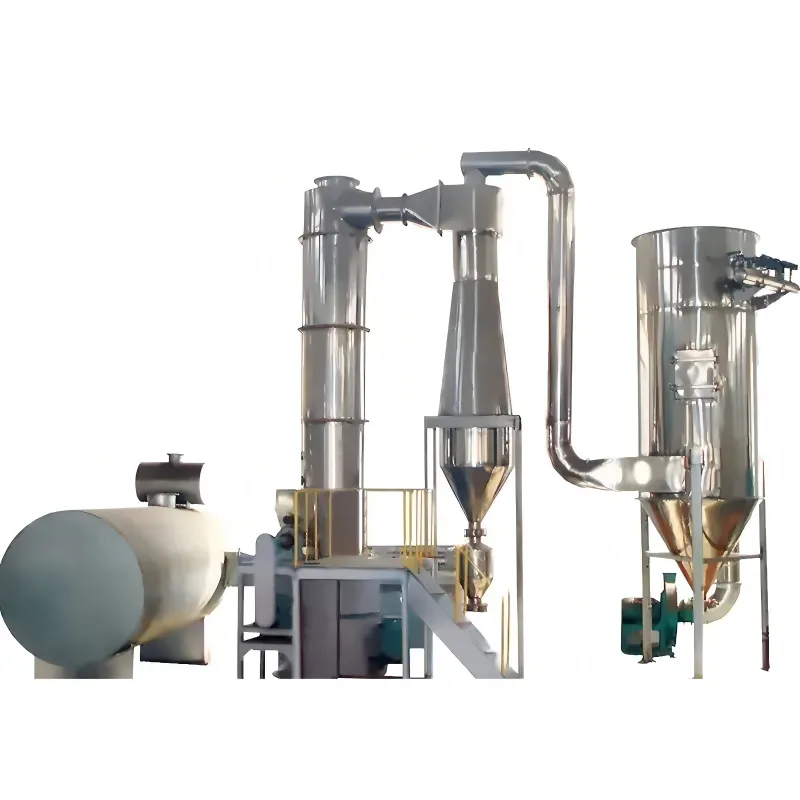
Spin Flash Dryer
XSG spin flash dryer for filter cakes, pastes and slurries. Dries, disintegrates and classifies in one chamber. Seven models evaporating 58–1,203 kg/h of water.
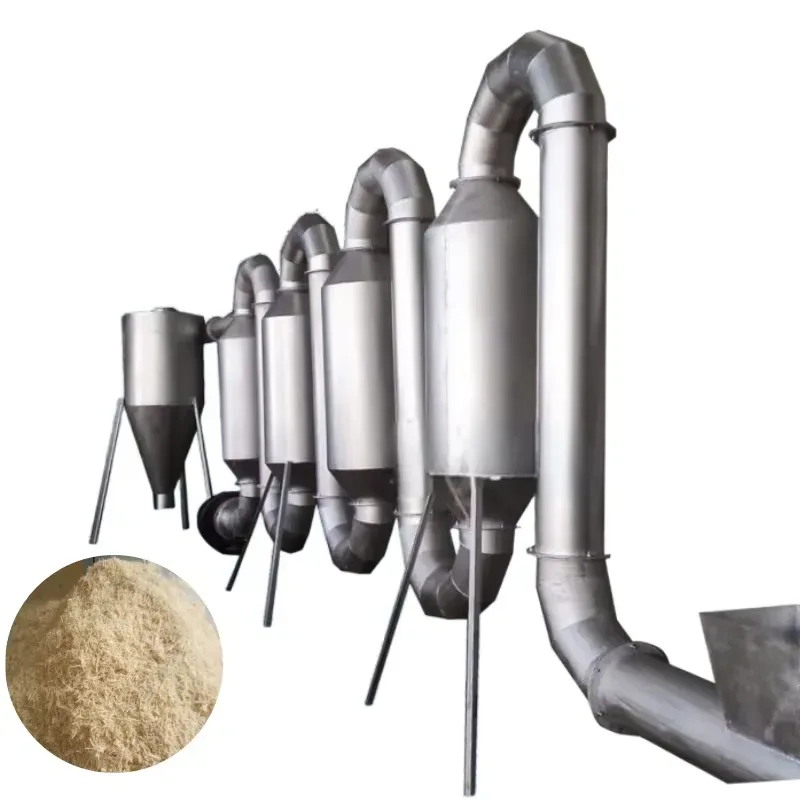
Pulse Flash Dryer
Pulse flash dryer using instantaneous airborne drying to remove free moisture from powders and granules at high throughput.